
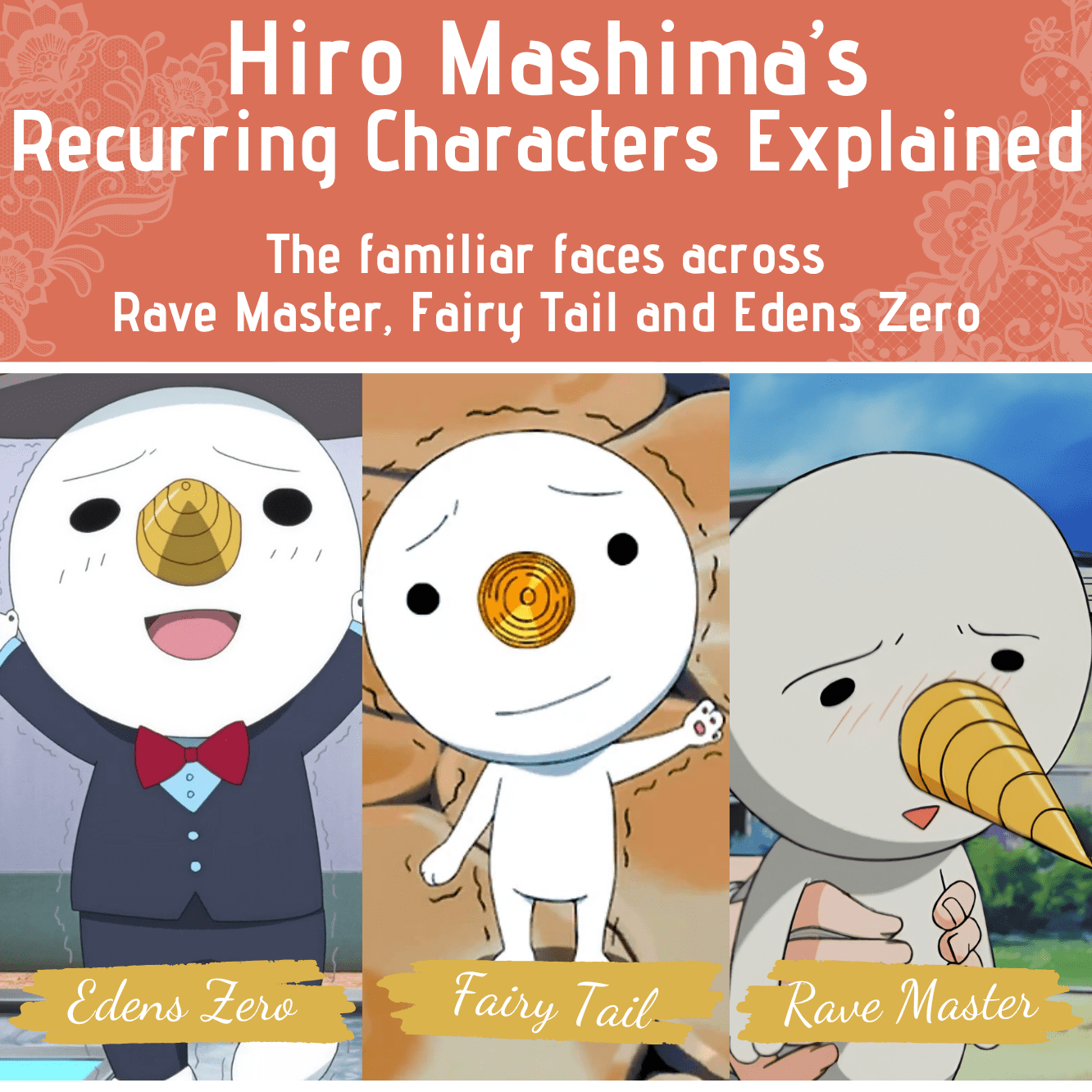
Hiro Mashima has a habit that his fans know well. From blue cats and strange little snowmen to tragic blue-haired mages and unstoppable red-haired warriors, Mashima has a long history of bringing familiar faces into new worlds. Every time he starts a new series, a familiar face turns up wearing a different outfit, carrying a different name, living in a different world.
For some of us fans, it feels like spotting an old friend. For others, it sparks the endless debate: is Mashima recycling ideas, or is he building his own interconnected creative universe?
The answer is actually closer to something manga has seen before: the Star System.
Popularised by legendary manga creator Osamu Tezuka, the Star System treats character designs almost like actors. The same “actor” can return in a completely different story, playing a new role with a new personality and history.
Mashima has created his own version of this idea across Rave Master, Fairy Tail, Edens Zero, Mashima Hero’s and beyond. Some of these callbacks are blink-and-miss-it background details. Others are so on the nose that Mashima himself has poked fun at them in crossover art.
Contents:
So let’s look at some of his most recognisable returning stars in this full breakdown of every recurring design, the series each one appears in, and what stays the same or changes between them.
Plue: The original Mashima mascot


Appears in: Rave Master, Fairy Tail, Edens Zero, and several Mashima works and cameos.
Before Natsu, before Happy, and before Fairy Tail became a worldwide name, there was Plue. Plue is Mashima’s oldest original creation, predating even his first published work as a school doodle of a trembling, ball-headed creature with a carrot-like nose. He has appeared in more Mashima titles than any other character and changes function dramatically each time.
In the 1998 one-shot Magician, Plue is a regular female dog whose bizarre appearance is the result of a super serum. In Rave Master, Plue is Haru Glory’s companion and the bearer of the Rave Stones. He is strange, adorable, loyal, and somehow manages to be one of the most memorable mascots despite barely looking like any real animal. In Fairy Tail, Plue returns through Lucy Heartfilia as a Celestial Spirit. This version belongs to the Nikora species and becomes more of a cute companion than a central quest character. In Edens Zero, the Nikora concept returns again, this time adapted into an alien species within the series’ sci-fi setting.
Happy: Same name, different universe


Appears in: Fairy Tail, Edens Zero
Happy is unusual among Mashima’s recurring characters because he keeps his name unchanged across both series rather than being given a new identity. Both Happys are blue cats with white stomachs who walk upright and speak. The only visual difference is the tail tip colour: white in Fairy Tail, black in Edens Zero.
The origin stories and nature of each character are entirely different. Fairy Tail’s Happy is an Exceed, a feline species from the parallel dimension of Edolas, and uses magic to sprout wings for flight. Edens Zero’s Happy is a cat from the planet Excede who was killed in a road accident and subsequently rebuilt as a robot, able to transform into a pair of blasters called the Happy Blasters for Rebecca to use.
Their personalities mirror their respective partners: the Fairy Tail Happy emulates Natsu’s reckless enthusiasm, while the Edens Zero Happy takes on Rebecca’s laziness and shut-in tendencies.
The hero: Haru, Natsu and Shiki


Appears as: Haru Glory (Rave Master), Natsu Dragneel (Fairy Tail), Shiki Granbell (Edens Zero)
Mashima’s main heroes often share similar DNA. Haru, Natsu and Shiki are not copies of each other, but they clearly come from the same creative family. They are energetic fighters who value friendship, protect the people close to them and usually charge directly into danger before thinking too deeply about the consequences.
There is even a naming pattern: Haru means spring, Natsu means summer, and Shiki means the four seasons collectively, suggesting a kind of culmination of the line.
Physically, all three follow the same mould: spiky hair, a muscular but boyish build, and a personality built around the hunger for friends and the willingness to fight for them above all else. The differences sit in the details. Haru wields a sword called the Ten Commandments with ten transformable forms. Natsu uses fire magic and is a Dragon Slayer. Shiki manipulates gravity through his Ether Gear, Satan Gravity.
Haru is the most grounded emotionally, Natsu the most impulsive, and Shiki notably more self-aware in his relationships with women than either predecessor. Hair colour distinguishes them most clearly at a glance: pink for Natsu, black for Shiki, and a more conventional dark tone for Haru.
The heroine: Elie, Lucy and Rebecca


Appears as: Elie (Rave Master), Lucy Heartfilia (Fairy Tail), Rebecca Bluegarden (Edens Zero)
Mashima pairs each male lead with a blonde, Western-named heroine. Elie in Rave Master wields Tonfa Blasters and carries a mysterious amnesia plot thread. Lucy Heartfilia in Fairy Tail uses Celestial Spirit Magic, summoning characters through keys, and drives several of the series’ most important story arcs with her own power. Rebecca Bluegarden in Edens Zero is a B-Cuber whose Ether Gear Cat Leaper allows her to leap backwards through time and eventually across parallel universes.
All three share a similar face, body type, and blue-and-white colour scheme in their most recognisable outfits. Their personalities, however, diverge considerably. Elie is an energetic amnesiac. Lucy is cautious, literary-minded, and emotionally layered. Rebecca is more self-deprecating and practical, defined by low subscriber counts and a determination to improve through effort rather than raw power.
The Jellal archetype: Sieg Hart, Jellal and Justice


Appears as: Sieg Hart (Rave Master), Jellal Fernandes / Siegrain / Mystogan (Fairy Tail), Justice (Edens Zero), Genesis (Mashima Hero’s)
This is Mashima’s most consistent recurring archetype. If he has a favourite character design to reinvent, this might be the one. Every version shares the same base: blue hair, a destiny intertwined with the red-haired heroine of the series, some kind of marking or activated effect around the right eye, and a trajectory that moves between opposing the heroes and eventually aligning with them (or sacrificing himself in the attempt).
Sieg Hart in Rave Master is an elemental mage of extreme power who undertakes a centuries-long vigil and makes a dramatic self-sacrifice. He is the template everything else draws from. Jellal Fernandes in Fairy Tail is a childhood friend of Erza’s who is brainwashed into becoming a villain before a long, painful road toward redemption as the vigilante leader of Crime Sorcière. Mystogan, a separate character in Fairy Tail, uses the same face and a disguise to hide it, which the series eventually explains in-universe. In Edens Zero, Justice is an officer of the Interstellar Union Army who spends the series in vengeful pursuit of Elsie Crimson before grief and realisation gradually erode his certainty. In Mashima Hero’s, Genesis is a fourth derivative who uses an imagination-based superpower and operates as a straightforward villain.
Across all four versions, the right eye is always the focal point: Sieg has a tattoo, Jellal has his iconic marks, and Justice’s Ether Gear manifests glowing lines around his right eye in exactly the same shape.
Erza Scarlet and Elsie Crimson: The warrior queens


Appears as: Erza Scarlet (Fairy Tail), Elsie Crimson (Edens Zero)
The moment Elsie Crimson appeared, Fairy Tail fans had one reaction: “Space Erza.” And honestly? They were not wrong.
Erza Scarlet is Fairy Tail’s S-Class mage with long red hair and an eyepatch covering the right eye she lost in childhood, a prosthetic eye replacing it later. Elsie Crimson in Edens Zero is a space pirate queen and former princess with the same long red hair and an eyepatch on her right eye. Their surnames are both varieties of red.
Both use armour-based fighting. Erza’s Requip Magic lets her cycle through hundreds of armour sets and weapons instantaneously, while Elsie’s Star Drain Ether Gear absorbs the Ether of a planet and uses it to conjure elemental armours. They share voice actresses in both Japanese and English. The main personality difference is that Erza tends toward strict, emotionally guarded responsibility, while Elsie carries a more easygoing and openly rebellious streak.
Wendy Marvell and Labilia Christy: A debated comparison


Appears as: Wendy Marvell (Fairy Tail), Labilia Christy (Edens Zero)
Some fans compare Wendy Marvell and Labilia Christy because they share surface-level design similarities: younger-looking female characters, long blue hair, and softer facial features common in Mashima’s art style. This is less a confirmed counterpart relationship and more a case of recognisable aesthetic overlap.
Wendy is one of Fairy Tail’s main characters, a young Sky Dragon Slayer whose story focuses on confidence, healing magic, friendship and slowly growing into her own strength. Labilia begins Edens Zero as Rebecca’s rival in the B-Cuber world, introduced as arrogant, attention-seeking and deliberately cruel before later chapters add more complexity to her character. Their personalities are almost complete opposites, which is precisely what makes the comparison interesting rather than straightforward.
Repeated Mashima Universe Ideas and Groups
Mashima’s reused ideas extend even further. Etherion appears across multiple works as a name connected to immense destructive or world-changing power. Element-based elite groups appear repeatedly. Certain weapons, abilities and transformation concepts echo between series.
Etherion and repeated concepts
Etherion appears across multiple Mashima works as a name connected to immense destructive or world-changing power. In Rave Master it is the ultimate magic capable of saving or destroying the world. In Fairy Tail a weapon of the same name exists as a devastating magical cannon. In Edens Zero the concept evolves further, becoming tied to the series’ central mystery around time and the Chronophage. Mildian similarly recurs: a village of mages in Rave Master and a city associated with the god of time, Chronos, in Fairy Tail.
Oración Seis: The group that keeps returning


Appears in: Rave Master, Fairy Tail, Edens Zero
Mashima reuses this name and structure across all three of his major series. In Rave Master, the Oracion Seis are the six elite commanders of the villainous organisation Demon Card. In Fairy Tail, they are a dark guild of six extraordinarily powerful wizards, introduced as major antagonists before some of them shift toward redemption arcs.
In Edens Zero, the concept splits into two separate factions: the Oracion Seis Galactica, a group of six notorious galaxy-level criminals including Elsie herself, and the Oracion Seis Interstellar, six elite officers of the Interstellar Union Army including Justice.
The structure of six powerful individuals operating as a named unit is the constant; the alignment, motivation, and ultimate fate of each group differ substantially.
The Element 4: Mashima’s elite elemental fighters


Series: Fairy Tail, Edens Zero
In Fairy Tail, the Element 4 are four elite soldiers of the Phantom Lord guild, each wielding one of the classical elements: fire, water, wind, and earth. The same structure reappears in Edens Zero with a group using the same name and the same four elemental divisions among its members.
Jiggle Butt Gang


Series: Rave Master, Fairy Tail
One of Mashima’s strangest recurring jokes, the Jiggle Butt Gang began in Rave Master before making their way into Fairy Tail. Unlike Mashima’s more serious reused concepts, this group is pure comedy: the same ridiculous energy, exaggerated designs, and absurd humour carried intact into a new universe.
What connects all of it

Mashima has described this practice as partly intentional fan service and partly efficient design, and he has never been shy about it. In official crossover art, he has drawn Natsu and Lucy dressed as Haru and Elie, and in Mashima Hero’s the characters meet each other directly, with the similarities between them played as an in-universe joke.
The result across his career is something closer to a shared visual language than simple reuse: the same archetypes placed into different contexts, given different burdens, and pushed toward different outcomes.
Mashima Hero’s fully embraces this by bringing characters from Rave Master, Fairy Tail and Edens Zero together in an official crossover.
With Dead Rock, Mashima continues experimenting with familiar visual language, although its darker fantasy setting separates it more from the direct Rave Master, Fairy Tail, and Edens Zero comparison chain. Whether those connections sharpen over time remains to be seen.
Whether you call them references, alternate versions, Easter eggs or Mashima’s own Star System, these characters have become one of the most recognisable signatures of his storytelling.





Leave a Reply