
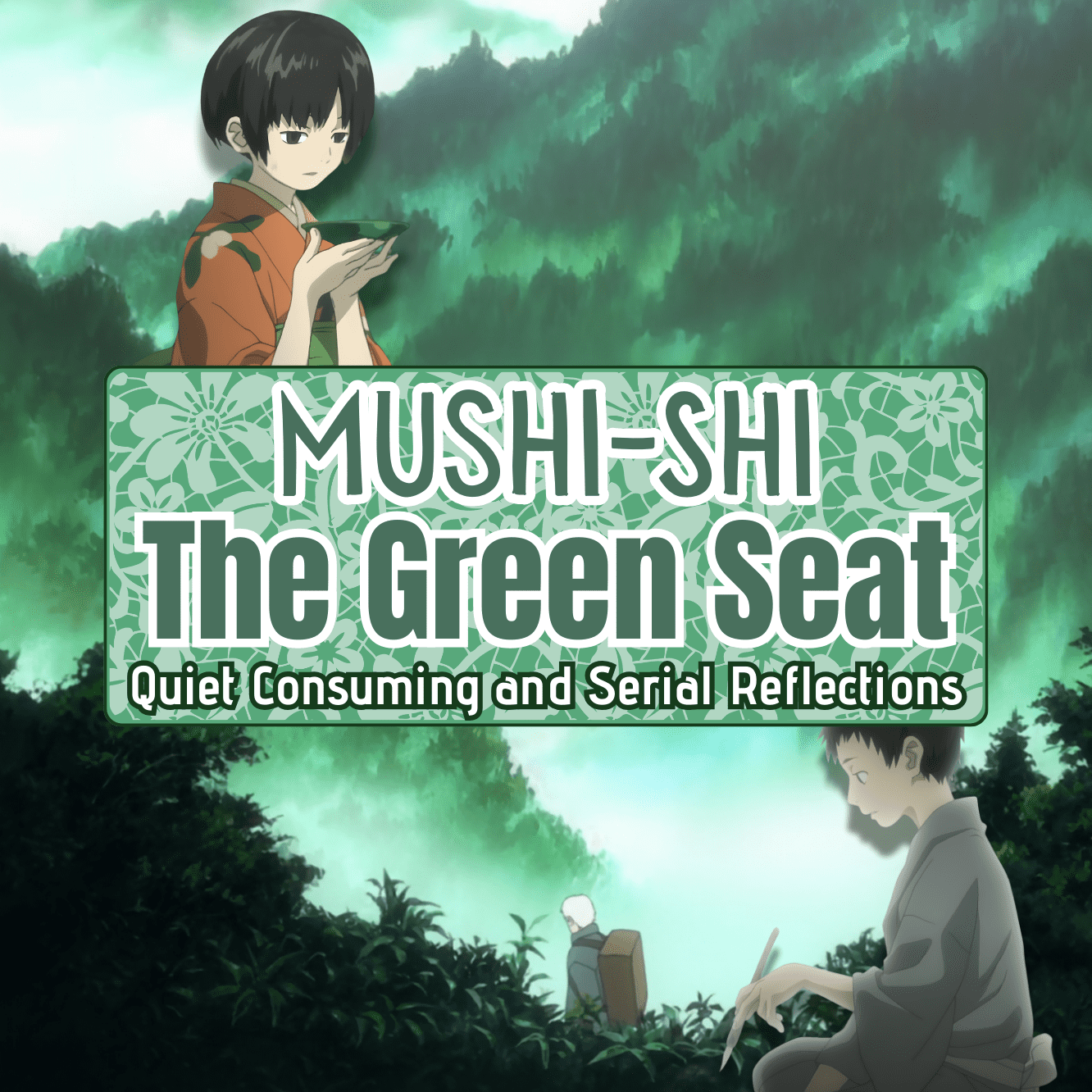
A boy, a forest, and drawings that refuse to stay drawings.
This was a rewatch, but it was also the first time I watched Mushi-Shi Episode 1: The Green Seat without any distractions. No second screen. No multitasking. Pausing when something felt dense. Letting my full attention be on this episode.
It was…difficult.
I mainly watch anime while doing something else, working, scrolling, half-listening. Mushi-shi does not reward that kind of viewing. Honestly, it resists it. The episode moves slowly, speaks sparingly, and trusts me, as the viewer, to notice the small shifts, sounds, framing, and breath. Most of which, sadly, get missed while I am multitasking.
Pst, this reflection begins my Serial Reflections project with Mushi-Shi, a series that actively resists binge-watching and instead invites patience, attentiveness, and quiet contemplation.
What is Mushi-Shi episode 1, The Green Seat, about:
- Series: Mushi-shi
- Episode: 1
- Focus: Creation, companionship, restraint
- Stream on: BiliBili and Crunchyroll

Ginko investigates a boy whose left-hand drawings take on a life of their own, soon realising that an unseen presence has been keeping the boy company.
My Quiet Reflection on Mushi-Shi Episode 1: The Green Seat
Mushi-Shi Episode 1: The Green Seat really sets the tone for the entire series with its deliberate slowness and emphasis on atmosphere over action. One of the first scenes features a long pan of the forest, capturing the way light filters through the canopy and the subtle rustle of leaves in the wind. Watching the English dub with full attention, pausing to absorb what I can, makes the episode hit differently. This initial scene immediately anchors the mood, inviting us to embrace the quiet and reflect on the deeper, almost meditative ambience that persists throughout the episode.
The English dub actors did a wonderful job this episode. Travis Willingham as Ginko carried an easy calm, a voice that never pushes or pressures. Luci Christian gave Shinra a fragile softness that makes his self-doubt feel all the more believable. Cherami Leigh’s Renzu was a gentle warmth that lingered even when she was barely on screen. The performances never strain for emotion; they let it surface naturally, which suits the series perfectly.

The scenery is tranquil, almost unreal. Long shots of the forest dominate the episode, leaves shifting in the wind, green stretching endlessly in every direction. The sound design does as much storytelling as the visuals. Wind through trees, distant birds, the subtle creak of the house, long stretches without dialogue. There’s nothing extra here, nothing competing for attention. The result is soothing, almost meditative, but also quietly suffocating.
Being that deep in the mountains, cut off from the rest of the world, would be incredibly lonely. Shinra’s life feels like a beautiful cage. Nature is always present, always surrounding him, yet there is no human connection beyond his grandmother’s lingering presence. The forest keeps him company, but it does not respond. It listens without answering.

One thing that stood out strongly on this rewatch was how rarely the anime shows full faces. We get close-ups instead—eyes, mouths, half-profiles, fragments of expression. Shinra’s hesitant eyes when he talks about beginning to doubt himself. Ginko’s steady, observant gaze as he takes everything in without rushing to judgment. Renzu appearing in soft, incomplete glimpses, never fully solid.
Those partial views create a strange mix of intimacy and distance. We’re close, but never fully allowed in. It mirrors the episode’s themes perfectly: things that are half-seen, half-felt, never fully grasped. This technique of fragmentary visuals reflects the series’ overall meditation on the unseen and the unknowable in life. Showing full faces would make emotions too explicit. Instead, we’re asked to read between expressions the way Ginko reads between events.
Ginko himself embodies that restraint. He doesn’t arrive to fix a problem so much as to understand its shape. He doesn’t condemn Shinra’s ability and doesn’t rush to suppress it, treating the unseen presence as something not inherently wrong. His solutions are subtle and understated. However, during his encounter, Ginko undergoes a subtle shift in perspective.
He moves from being merely an observer to embracing a more interactive role, recognising the nuances and potential of Shinra’s unique connection with the mushi. This realisation highlights his evolution from a passive traveller to someone who actively nurtures and respects the delicate balance of the world around him.

Even his final act, quietly pocketing the green wine cup as he slips away, that subtle, satisfied smile flashing in the forest light, feels somewhat cheeky rather than sinister. Ginko is lowkey a ‘thief‘, and somehow it fits. He doesn’t destroy or force. He repositions. He balances.
The episode’s explanation of mushi is another example of this approach. Ginko’s long analogy about the hand and the place of mushi “closest to the heart” is one of the clearest explanations we ever get, yet it never feels like exposition. It’s poetic, sensory, grounded in something physical and familiar. Rather than reducing mushi to a concept, it keeps them elusive.

Several lines from the English dub linger long after the episode ends. Shinra’s quiet admissions, how his grandmother never believed him, how he began to doubt himself, carry enormous weight without being dramatic. Luci Christian’s delivery makes those lines feel fragile, almost embarrassed to exist. And Ginko’s observation that “it’s not easy to communicate a sensory experience” lands especially hard in that context. When no one believes what you perceive, the damage isn’t loud. It’s internal. It teaches you not to trust yourself. (I will share my transcribed quotes from the series soon. I just want to build up enough to make a quote post worthwhile.)
What strikes me most about The Green Seat is that I never found it unsettling. There’s no sharp turn, no moment designed to frighten. The episode remains calm throughout. If there’s discomfort here, it comes not from danger, but from stillness. From how easily something gentle can settle into permanence.

Next comes Mushi-Shi Episode 2: The Light of the Eyelid, an episode about vulnerability, confinement, and the cost of adaptation. But The Green Seat lingers quietly, like something that never quite leaves.
What can you discover in the quiet moments of your own life? Perhaps the lingering echoes of this episode invite you to notice the subtleties around you, to find understanding in stillness, and to see the unseen in everyday experiences.








Leave a Reply