
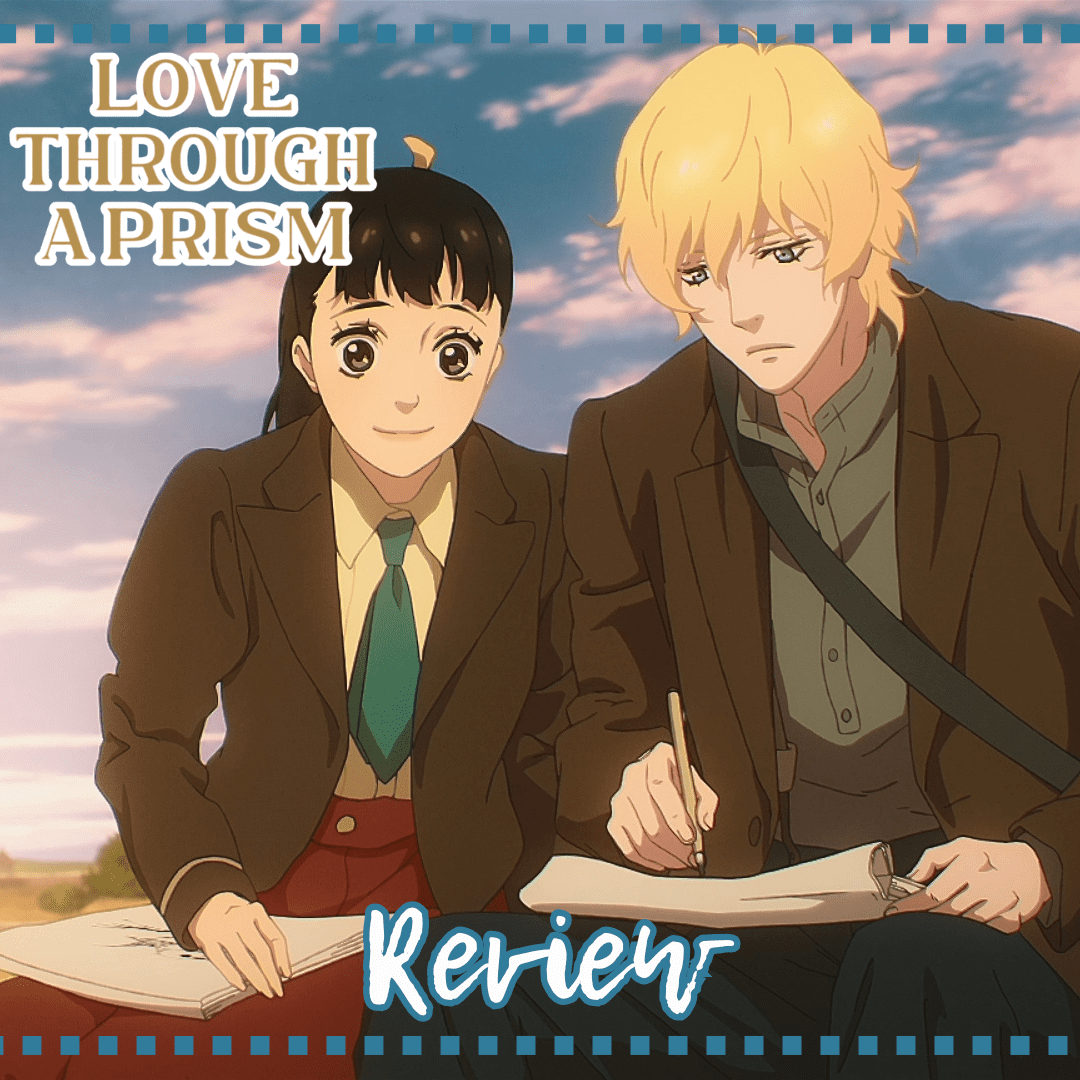
I chucked “Love Through a Prism” onto my to-watch list months ago after seeing a teaser of misty London streets and oil paints. Then, one random anime wheel spin later, it popped up on a quiet Saturday night, and I thought, “Why not?” I ended up glued to the screen until the credits of episode 20 rolled, feeling sad, happy, and properly teary-eyed all at once.
I watched the English dub and finished the entire series in one sitting. It pulled me through that familiar emotional cycle that drama anime sometimes does so well. Happy, sad, slightly frustrated, and a little teary-eyed by the time the final episode finished.
What surprised me most was how visually captivating it was. The scenery in this anime is genuinely beautiful. Not in an exaggerated or flashy way, but in the kind of way that makes you pause the screen because the lighting, colours, and backgrounds look like artwork. I took an embarrassing number of screenshots while watching, and several of them have already ended up in my wallpaper folder.
So yes. This random recommendation turned into a five-hour binge and a full review.
Trace the brushstrokes
Tap any section below to jump straight there in the review.
Quick review

- Visual Storytelling: Scenery and colour symbolism so breathtaking I paused every other minute for screenshots; the palette literally carries the emotion.
- Emotional Depth: Bittersweet, introspective, and quietly hopeful; it leaves you sad, happy, and teary all in one sitting without ever feeling manipulative.
- Character Dynamics: A small friend group whose relationships evolve naturally over time.
- Romantic Focus: Complicated by timing, duty, and personal choices rather than simple attraction.
- Vibe: A reflective, late-night watch that works best when you let yourself sink into it.
What is Love Through a Prism about?
- Full genre list: Drama, Romance, Historical, Visual Arts
- Key themes: Artistic passion, colour as emotion, found family in a foreign land, healthy vs unhealthy love, talent vs effort, grief and recovery
- Type: Series (ONA)
- Episodes: 20
- Duration to watch in full: +/- 8 hours 30 min
- Age restriction: TV-PG / PG-13
- Trigger warnings: Grief over suspected death, depression/trauma symbolism
- Release date: 15 January 2026
- Animation studio: Wit Studio
- English dub: Yes
- Source: Original (with a manga adaptation that started alongside)
- Kanji: プリズム輪舞曲〈ロンド〉
- Alternative title: Prism Rondo
- Average rating: 8.4/10
- Where to stream: Netflix
- Does the story continue in the source material?: No
- Official hashtags: #LoveThroughAPrism #PrismRondo #プリズム輪舞曲

In early-1900s London, Japanese exchange student Lili Ichijouin arrives at the prestigious Saint Thomas Art Academy determined to become a professional painter. Surrounded by talented classmates, rivalries, and the vibrant yet challenging world of fine art abroad, she finds herself drawn to the enigmatic aristocrat Kit Church while building deep friendships that force her to confront what she truly wants from love, life, and colour itself.
My Thoughts on Love Through a Prism
I’ll start with what hit me first: the backgrounds. Wit Studio has made extraordinary-looking anime before; if you’ve spent any time at all on my reviews of their work, you’ll know I have a pattern of reaching for screenshots whenever they’re involved, but Love Through a Prism does something slightly different.

The brushstroke texture applied to every surface makes the world feel like it has been painted rather than rendered: wildflowers crowding a stone bridge, the Gothic spires of Saint Thomas Art Academy framed through autumn leaves, a steam train cutting across rolling English hills with smoke trailing behind it.

The London streets are busy with early motorcars and river barges, the skyline sitting hazy in the distance. Then the series will cut to something like a zoo pond full of flamingos, or the White Cliffs at sunset with two figures standing too far apart on the sand, and you realise the colour is doing as much narrative work as the script.

My screenshot folder is embarrassingly large, especially the additions from this anime to my scenery collection. I have made several of them my wallpaper, and I do not regret it.
The early episodes are light. Lili is warm, determined, and just a little bit reckless in her choices. Kit is the kind of character who gets on your nerves before he gets under your skin. He’s selfish, he’s impulsive, and he’s stubborn. I didn’t like him much through the first few episodes. But by episode 7, I was fully on his side and slightly desperate for things to go well for him.

Dorothy Brown is probably the character I found myself thinking about most after the series ended, which surprised me. She’s Lili’s housemate and first friend in London, practical, warm, with an accent from the Cotswolds and a very clear sense of what she wants from her life.

Dorothy is in love with Joffrey O’Brien, and Joffrey is in love with her, and they both know it, and they do nothing about it. Not because of cowardice. Because Dorothy has looked honestly at the shape of her life, her village, her family, the life she wants to build, and she knows that Joffrey, wonderful and fond as he is, would be a good boyfriend and a difficult husband. It would not work. So she doesn’t pursue it. She goes home and marries someone else and has three children and still shows up at Joffrey’s pub, because the friendship is real and the friendship stays. I found that quietly devastating in the best possible way. It’s the kind of story choice that most romance anime avoid entirely, because it resists the tidy resolution. Love Through a Prism makes it the clearest-eyed relationship in the whole series.

Peter Anthony is the weak point in the ensemble, and I’ll own that disappointment plainly. He has a conflict, the jealousy of someone watching a more talented friend succeed, the loss of motivation that follows, and the wall that hits you when your passion runs dry. Those are real experiences, and the series gestures at them. But Peter never got enough room to breathe. We see the problem; we don’t really feel it from the inside. He seems to resolve it and rejoin the group without the process being shown. Of the main friends, he’s the one who felt most like a sketch rather than a finished painting.

Shinnosuke “Shin” Kobayakawa is more complicated to assess. I could see the arc that was built for him, and I understood what he represented in Lili’s story: the stable choice, the man who clearly loves her and with whom she could build a sensible life. I didn’t mind him being there. What I minded was watching him give up sculpting.

The series sets up his dedication to it, and then he stops, and his reasoning didn’t hold together for me. A creative person deciding to stop creating deserves more than the weight it received here. I was glad when he and Lili called off the engagement, not because of Kit’s return, but because it was the right thing for both of them. That particular decision felt honest. The sculpting thread didn’t.
The section of the series rendered in black and white, roughly coinciding with Lili’s return to Japan and her period of grief after Kit is presumed dead, is where the show does something genuinely interesting. It’s a visual choice that communicates exactly what’s happened to her: she has stopped seeing colour. Her parents know she’s stopped painting. Everyone around her can see the absence. The problem for me was that it stayed on the outside. We watched the grey. We didn’t hear her speak about it.

There’s a scene that doesn’t exist that I kept waiting for, Lili telling someone, in her own words, that she can’t see the colours any more. That she knows they should be there and they’re just not. The colour returning slowly with Kit’s return is beautiful. I wanted one moment where someone named what had happened to her, where she said it aloud, where there was a response to that admission. Without it, the device lands as atmosphere rather than character work.

The final episode rushes its resolution. Ten years of absence, grief, and rebuilding are compressed into a reunion and then a montage of endings, some satisfying, some that deserved their own episode. Joffrey’s pub. Dorothy with her children. Shin in Italy. These feel like postcards rather than conclusions. And then the stinger after the credits, Lili and Kit finding the lily cave in Sumatra, finally. That moment is genuinely lovely. The series earned it. I just wanted more time in it and with them.

The soundtrack is predominantly instrumental, heavy on strings and piano, with a classical and cinematic feel that fits the period without being ornate about it. The theme song “Star Flower” by Chilli Beans. sits lightly over the opening and earns its place. The English dub cast does solid work throughout. Christopher Bonwell as Kit handles the shift from difficult to warm without making it feel like a different character, and Leader Looi grounds Lili in a way that keeps her watchable even during the episodes where her inability to communicate her feelings becomes frustrating.
Overall Enjoyment and Personal Reflections

Watching Love Through a Prism felt like finding something I hadn’t realised I was looking for. I went in expecting a nice romance with good animation and came out having had the Dorothy conversation stuck in my head. The series is not perfect. I’ve listed the places where it isn’t, and I stand by all of them. But perfection isn’t what made me watch it in a single sitting, or screenshot half the backgrounds or sit quietly through the credits trying to work out how I felt.
What it made me think about, genuinely, is the gap between what we want and what we’re prepared to say out loud. Most of the grief in this series, Lili’s, Kit’s, Dorothy’s, even Shin’s in his way, comes from things that were felt but not spoken. Colour that was lost but never named. Feelings that were obvious to everyone except the person who needed to hear them. The series doesn’t resolve that neatly, and I think that’s correct. That’s what it’s actually like.
In summary, this anime can be described as…

A period romance that treats love as one element in a fuller life rather than the answer to it. It is patient, visually committed, and emotionally generous with its supporting cast. It asks what it costs to pursue what you love, and it doesn’t pretend the answer is simple.
Strengths and weaknesses

Strengths:
- The backgrounds and visual design are the best work Wit Studio has produced in recent memory, and that is a high bar to clear.
- Dorothy’s storyline refuses the easy romantic resolution and is better for it. It stands as the most emotionally mature piece of writing in the series.
- The ensemble cast is genuinely distinct, with each character’s relationship to art telling you something real about who they are.

Weaknesses:
- The final episode is badly paced. Too much resolution is packed into too little time, and what should have been a satisfying conclusion feels compressed.
- Peter Anthony’s arc is underwritten. The potential was there; the execution wasn’t.
- The black-and-white grief sequence needed one more scene, something from Lili herself, spoken aloud, to complete what the visuals were doing.
Bingeability, is it an easy watch?

I watched all 20 episodes in a single sitting, which tells you most of what you need to know. The pacing in the first half is light and warm enough to carry you forward without effort. The second half, from the war onwards, gets heavier, but by that point you’re invested enough that the weight doesn’t make you want to step back. It’s not an effortless watch, the way something plotless and comforting is, but it doesn’t require you to steel yourself either. I’d call it an absorbing watch rather than a demanding one. Best experienced with an evening clear ahead of you.
Re-watch value

High, once some time has passed. The first half rewards a second watch, specifically, you’ll catch Kit noticing Lili in scenes where he’s pretending not to, and small details in the backgrounds that shift subtly with the emotional tone of the story. I wouldn’t rewatch the final two episodes immediately; they need a bit of distance first. But I’ll come back to the middle section of this series. The countryside episode in particular.
What will stay with me

Dorothy telling Lili, plainly and without self-pity, that she knows Joffrey would not make her happy in the long run. Not because he’s a bad person, he isn’t, but because she knows what her life needs to look like, and he doesn’t fit that shape. And then her choosing that life anyway, fully, without resentment. There’s no scene of her crying about it. She just decides, and keeps the friendship, and gets on with things. That scene doesn’t resolve into anything. It stays complicated. I think about it more than I think about the main romance.
Favourite moments

My favourite moments come from episode 3, where Kit and Lili find a robin and draw it together, both of them crouched over their sketchbooks, competing without quite realising they’ve stopped competing. It’s a small scene. Then later in the same episode, they end up in a field of lilies and draw those too, side by side, in the kind of silence that only happens between people who are starting to understand each other. Neither moment announces itself as important. That’s exactly why it works. It’s the scene that told me the series knew what it was doing, and after it, I stopped checking how many episodes were left.
Favourite character: Dorothy Brown

Dorothy is the most honest character in the series. She sees the situation clearly, she names it to herself and to others, and she makes her choices with open eyes. I respect her more than any other character in the ensemble.
Quick questions and answers

Is Love Through a Prism a romance anime? Yes, but it’s more than that. The central love story between Lili and Kit is the spine of the series, but the show gives equal attention to each character’s relationship with their art and with the choices their lives require of them. The romance is present throughout; it’s rarely the only thing happening.
Does Love Through a Prism have a happy ending? Yes — with qualifications. There is a reunion, there is a choice made, and the post-credits epilogue shows the supporting cast in lives they chose for themselves. It’s not a neat bow, but it’s satisfying. Years of separation don’t disappear, and the series doesn’t pretend it does.
Is Love Through a Prism worth watching? Yes, particularly if you have any interest in period romance, art-focused storytelling, or a series that handles its supporting characters as seriously as its leads. It has real flaws, the final episode especially, but those don’t undo the quality of what comes before.
Is Love Through a Prism suitable for beginners? Yes. It doesn’t require prior knowledge of any source material, the pacing is approachable, and it’s available with an English dub. The genre is conventional enough that anyone who’s watched any romance drama series before and enjoyed it will find their footing quickly.
Does Love Through a Prism have a satisfying ending? Mostly. The central arc resolves well, and the reunion earns its emotional weight. The supporting characters’ conclusions feel rushed; they’re given epilogue cards rather than proper scenes, and that does blunt the satisfaction slightly. If you need every thread tied with care, you’ll feel the compromise. If you’re invested primarily in Lili and Kit, you’ll leave happy.
Would I recommend it?

Yes. Specifically to anyone who enjoys slow-burn period romance, Wit Studio’s visual work, or series that take their ensemble seriously. If you need your romance leads to be emotionally communicative, budget for frustration; neither Lili nor Kit makes that easy. If you can sit with the slow build and the missed moments, this series will pay that patience back.
It is not for viewers who want a purely light watch. The war section is not graphic, but the grief is real, and it sits in the story for a while. Go in knowing that the second half carries weight.
Have you watched Love Through a Prism?

What did you make of the Dorothy and Joffrey storyline? Do you think she made the right call? The black-and-white grief sequence is one of the more discussed stylistic choices in the series. Did it land for you, or did you want more from it? Will you be watching Love Through a Prism? Let me know in the comments below!
My Rating: 8/10
| Story | Animation | Sound | Characters | Pacing |
| 8 | 9 | 7.5 | 8.5 | 7 |
A series that does more right than wrong, with a supporting cast that earns genuine affection and a visual style that carries its own argument. The final episode doesn’t stick the landing it deserved, and a few threads are left thinner than they should have been. None of that takes away from the best of what this series is.
Date Watched: 14 March 2026







Leave a Reply