
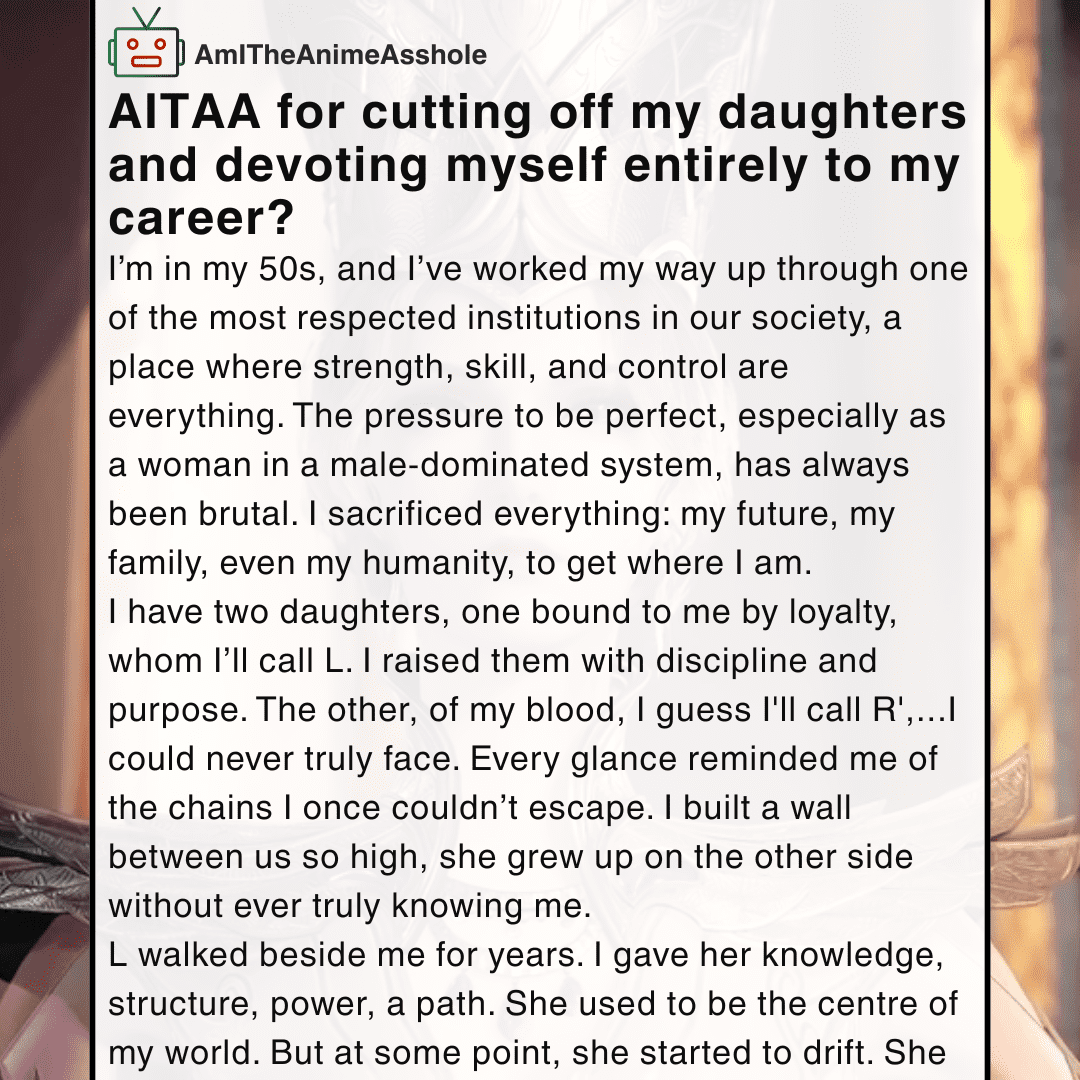
What happens when power, pain, and parental failure collide? This fictional AITA thread imagines what this Soul Land character, Bibi Dong, might post if she aired her deepest regrets on Reddit. But is she truly the villain… or just another casualty of the world she tried to conquer?
Yes, I take some creative liberties and play with wiggle room, but that’s part of the fun with this style of creative writing.
AITAA for cutting off my daughters and devoting myself entirely to my career?
I’m in my 50s, and I’ve worked my way up through one of the most respected institutions in our society, a place where strength, skill, and control are everything. The pressure to be perfect, especially as a woman in a male‑dominated system, has always been brutal. I sacrificed everything: my future, my family, even my humanity, to get where I am.
I have two daughters, one bound to me by loyalty, whom I’ll call L. I raised them with discipline and purpose. The other, of my blood, I guess I’ll call R’,…I could never truly face. Every glance reminded me of the chains I once couldn’t escape. I built a wall between us so high, she grew up on the other side without ever truly knowing me.
L walked beside me for years. I gave her knowledge, structure, power, and a path. She used to be the centre of my world. But at some point, she started to drift. She made allies I couldn’t condone (people who’ve openly undermined the very institution I bled and shed blood to uphold) began challenging my decisions, and questioned the very values I built my life on. She let mercy cloud her resolve, questioning choices she once obeyed without doubt.
I won’t lie, I’ve made cold decisions. I’ve prioritised power and prestige. I’ve betrayed people I once loved. Some say I’ve let my ambition consume me. But I’ve kept order. I’ve protected our people, even if it meant becoming the villain in my own daughter’s eyes.
They don’t know the truth of how I rose here, what it cost. That I was once betrayed…”poisoned”… by someone who called me their disciple. That I had to become the monster they feared, just to survive the abyss they left me in.
Now L refuses to speak to me, others call me cruel, and R has made it clear she intends to bring everything I’ve built crashing down. But I did what I had to do to survive in a world that devours the weak.
AITAA?
In canon, Bibi Dong never reconciles with her adopted daughter, Hu Liena. Their relationship was forged in discipline, loyalty, and expectation, but rarely warmth. This post captures her voice as if she wanted to explain herself, but still couldn’t let go of the throne she bled and shed blood for.
Bibi Dong’s Descent and Defence

Before she was the Supreme Pontiff, Bibi Dong was a prodigy, a young woman with twin spirits, revered for her strength and feared for what it could mean. Her brilliance was her blessing… and her curse. In a society where power was hoarded and women were bartered, her rise was never going to be clean.
She trusted her mentor, Qian Xunji. He shaped her power. Then, he stole her future. The man who called her “disciple” also made her his prisoner, emotionally, spiritually, and physically. What followed wasn’t just a betrayal, it was a violation that left her pregnant with a child she could never see as anything but a scar.
From that moment, Bibi Dong stopped reaching for light. She clawed her way upward, alone, armoured in cold ambition. She rejected love as weakness, viewed loyalty as a currency, and rebuilt Spirit Hall into an empire so strong it bowed to no dynasty, sect, or man.
Bibi Dong’s Ruthlessness

Bibi Dong justifies her ruthless rise to power as a necessary sacrifice for survival and order in a brutal, patriarchal world. Her choices were shaped by:
- Betrayal by her master, Qian Xunji, who raped and manipulated her.
- Loss of her first love, Yu Xiaogang, who never truly understood her pain.
- Oppression within a world where compassion is weakness, and power is the only shield.
She channels this pain into control, forsaking personal connections to become the God of Rakshasa—a being of death, judgment, and cruelty. And in doing so, she builds an empire… but loses her family.
Bibi Dong’s transformation into the Rakshasa God was not just symbolic; it was a divine coronation of trauma. In seeking power to protect herself and her legacy, she accepted a path that demanded cruelty, sacrifice, and spiritual corruption. The God of Rakshasa does not choose saints. It chooses those who’ve suffered deeply and are willing to make others suffer in turn.
Hu Liena: The Disciple, Not the Daughter

Though Hu Liena was never formally disowned or cast out, their relationship remained one of duty, not intimacy. Bibi Dong valued her as an heir, a weapon, and perhaps… the daughter she wished she could have had. But even then, Liena was not spared the coldness of a woman who no longer believed in love, only legacy.
Qian Renxue: The Blood That Broke the Bond

Born of violence, a living reminder of betrayal, Qian Renxue was the child Bibi Dong could neither claim nor love. Her very existence reopened wounds that had never healed. So Bibi Dong walled her off, emotionally, politically, even spiritually. Where Bibi Dong built an empire to bury her pain, Qian Renxue became the flame set to raze it. Not out of rebellion, but righteousness. Their connection was not severed by choice, but forged in silence. Estranged not through distance, but absence.
In Summary:

Bibi Dong does not ask for forgiveness, only understanding. She sees herself as the inevitable product of a world that rewards cruelty and punishes compassion. In her eyes, the “monster” she became was not born, but made, cut from betrayal, forged in silence, and crowned by necessity.
Her story isn’t one of redemption, but reckoning. She sacrificed warmth for order, love for loyalty, and humanity for control. And now, standing at the peak of power, she asks a question not for sympathy, but for judgment:
To Bibi Dong, power was not glory; it was protection. The throne wasn’t her prize; it was her barricade. She didn’t want to rule the world. She just never wanted to be ruled again.
Does survival excuse the scars it leaves behind?
What’s Your Verdict on Bibi Dong?
Drop your verdict in the comments, I’ll drop mine there too.
YTA – You’re the Asshole
NTA – Not the Asshole
ESH – Everybody Sucks
NAH – No Assholes Here






Leave a Reply