
How to read manga is one of the first things new manga fans need to learn when starting their manga journey. Just know, it’s also one of the easiest things to learn. If you open the manga with the left cover and not the right, as one would for a typical book for us, you are likely to get a section showing you how to read your manga. For many of us readers, that moment becomes part of the manga experience itself. Don’t worry, this is completely normal, and it’s actually one of the easiest things to learn.
Let’s break down exactly how to navigate these pages so you can start reading with confidence.
The Golden Rule: Right to Left

Manga is read right to left, following traditional Japanese reading direction. That applies to everything on the page: panels, speech bubbles, and even sound effects. It also applies to the pages and how you turn them.
How to Read Manga Right to Left
- Start at the “back” of the book (what feels like the end for a Western book). The front cover usually has the title and art facing you properly when you flip the whole book around.
- On each page, begin at the top-right panel and read right to left.
- Move down to the next row of panels and repeat: right to left.
- Speech bubbles and text follow the same rule, so read them from right to left too.
- Turn the page (you’ll get the hang of the flow quickly!).

It is the reverse of how most books and comics are read in South Africa.
How Long Does It Take to Get Used to Reading Manga?
Give yourself a little grace here; it genuinely does feel strange at first. Your eyes and brain have spent years being trained to move from left to right, so the first few pages of your first manga might feel like you’re fighting yourself. You might catch your eyes drifting the wrong way, re-reading a panel you’ve already seen, or struggling to figure out which speech bubble comes first. All of that is completely normal.
Once you get the hang of it, it becomes second nature surprisingly quickly. Manga is an incredibly visual, structured medium. Most manga creators (mangaka) and their publishing teams are highly skilled at guiding visual flow. Your eyes will naturally follow the intended path without you even realising it. The panel compositions, the direction a character is running, the tilt of a sword, and the placement of speech bubbles are all meticulously designed to guide your eyes naturally across the page.

A useful trick in the beginning is to let the art guide you rather than trying to map out the panel order in your head. Follow where the characters are looking, where movement is pointing, where the energy of the page leads you. Well-structured manga rarely leaves you genuinely confused about where to go next. If you’re ever unsure, check the speech bubbles; their positioning almost always tells you the reading order.
Sound effects work the same way. Large stylised lettering placed inside the artwork might feel like decoration at first, but it follows the same right-to-left flow. In many English releases, they’ll be translated or romanised, but even when they aren’t, context usually makes them clear. A crash is a crash, whatever the lettering looks like.
You might even find yourself trying to read Western comics from right to left afterwards! This is a common and rather funny side effect of the adjustment. Once it clicks, you stop thinking about direction entirely and just focus on the adventure.
The “Wrong Direction” Page, and Why It’s Not Always There
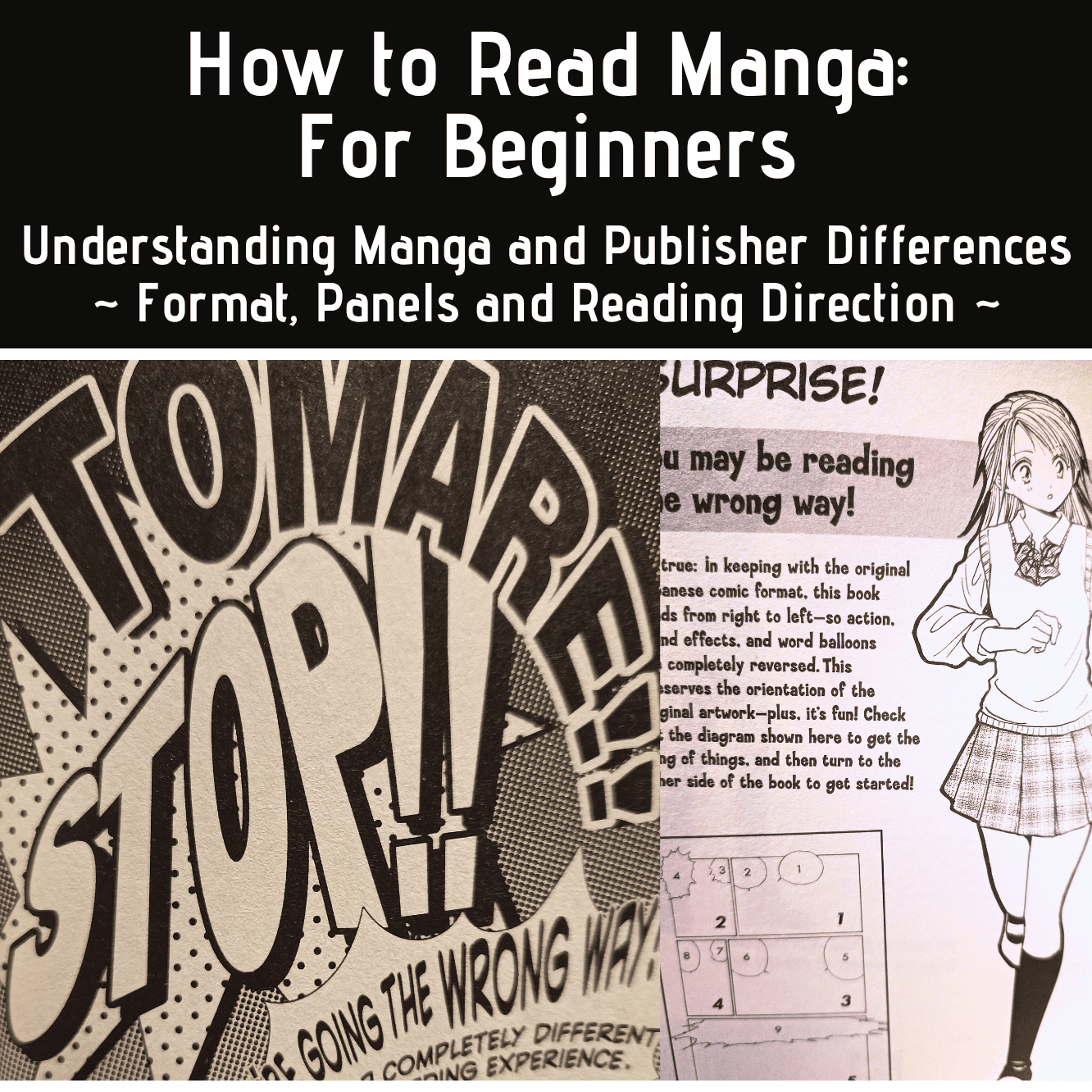
As you build your collection, you will notice that if you accidentally open a manga from the Western “front” cover, you will often find a dedicated “Stop! You’re reading the wrong way!” page. These are known as “reading direction” or “how to read” pages.
Why Do Some Manga Include This?
Publishers include these pages primarily as a helpful safety net for newcomers. Because manga has exploded into mainstream global popularity, thousands of readers pick up a volume every day without knowing its unique history. These pages prevent instant confusion, explain the layout simply, and orient the reader immediately.
Why Do Other Manga Leave It Out?
You won’t find these warnings in every single book. There are a couple of reasons for this:
- Target Audience & Age: Manga aimed at older demographics (like Seinen or historical drama) often assumes the reader is already an experienced manga fan who doesn’t need a tutorial.
- Imprint Consistency: Some publishers choose to keep the pages cleaner to preserve the presentation of the original tankōbon format.
- As manga grows in popularity, many publishers assume that most readers already know how to read it. So, they stopped including the instructions to save space and reduce costs.
- Digital releases are another place where the page is often absent. When you’re reading on an app, the platform itself usually handles reading direction, either through how swipe controls are set up or through a brief onboarding note when you first open the reader. The physical notice becomes redundant when the technology is already doing that work.
If you pick up a manga and there’s no guidance page, don’t panic. Check the spine: if it’s on the right side when the book is closed, you’re probably holding it correctly. You can also look at the page numbers. In a right-to-left manga, the numbers increase as you move from right to left, so if the page numbers are going in the direction that feels “backwards” to you, you’re actually on track.
Different “Wrong Direction” Page Styles Showing How to Read Manga
Over the years, I have seen some wonderfully creative approaches to this. As you can see from the photos of my own physical collection, these pages come in many different styles.
1. The Dynamic Character Cameo

Some publishers love to use the characters from the book itself to deliver the warning. For instance, in Naruto, you might see the main character tumbling upside down to catch your attention and the feeling of reading backward. In Bleach, characters might be shown interacting with the book layout itself. It keeps the tone fun, lighthearted, and perfectly aligned with the story you are about to read.
2. The Traditional Editorial Layout

Series like Blue Exorcist use a beautifully detailed, full-page editorial approach. It gives you a clear numbered panel diagram, a quick text description, and a little historical context from the editor about why we read it this way.
3. Minimalist and Elegant

For more mature or historically grounded series (like the historical drama Ōoku: The Inner Chambers) the publisher opts for a highly sophisticated, clean, and minimalist approach. There are no frantic cartoon arrows; just an elegant piece of traditional Japanese family crest artwork and a simple, respectful note explaining that the book is printed in its original format to preserve the artist’s original vision.
4. The Quick Visual Guide on How to Read Manga

In books like Angel Beats! Heaven’s Door, you get the best of both worlds: a clear publishing copyright page alongside a neat, generalised reading diagram. It doesn’t take up the whole page, but it gives you a quick, foolproof reference map if you ever get lost.
Ways Publishers Handle These Pages
One of the fun things about collecting manga is seeing how different publishers approach these warnings. Some are simple and functional, while others turn them into part of the experience.
Viz Media, the largest manga publisher in the English-speaking market, uses a template that has become something of a gold standard. It fills a full back page with a large, bold headline (“You’re Reading in the Wrong Direction!!”), a short editor’s note explaining the history of right-to-left formatting and why Viz chose to preserve it rather than flipping the artwork, and a numbered panel diagram showing exactly how to navigate the page. Each Viz title gets its own version with a character illustration pulled from that specific series, so the page feels connected to the book you’re holding rather than like a generic insert. Blue Exorcist shows Yukio Okumura peering over a book; One Piece has Luffy mid-sprint; Bleach features one of its characters in a typically dramatic pose. Some newer printings use a slightly smaller panel, but the same information is there.
Tokyopop, which was one of the most influential early English manga publishers, went with a more visually dynamic approach. Their version uses the Japanese word tomare (止まれ), meaning “stop”, displayed in bold lettering above or inside a downward-pointing triangle that mimics the Japanese road sign for stop. It’s punchy, immediate, and a little cheeky — it treats the redirect as a fun moment rather than a dry instruction.
Del Rey Manga, which was the manga imprint of Random House from 2004 to 2010, used a warmer, softer approach. Their version normally opens with the word “Surprise!” and features a character illustration from the book alongside a more conversational tone, the kind of writing that sounds like a friend explaining something rather than a publisher including boilerplate text. The panel diagram is there, but it’s presented as a helpful aid rather than a warning.
Seven Seas Entertainment usually takes the most compact approach. Rather than a dedicated full page, they tuck a small “Reading Directions” box into the corner of the credits page, with a brief explanation and a numbered diagram. It’s efficient and unobtrusive — the kind of inclusion that says “we’ll tell you what you need to know without making a production of it.”
Some publishers go in the opposite direction entirely, choosing a minimal, almost understated approach. Then there are publishers who fold the reading guide directly into the story itself, using actual manga panels as the hook. Rather than separating the notice from the content, the first thing you see is an action scene or a dramatic moment, with the reading direction information appearing below it in a smaller text block. This approach is particularly effective because it gives you something to look at while absorbing the instructions.
Why Manga Keeps the Original Reading Direction

You might wonder: Why don’t publishers just flip the images so they read left-to-right? If you had read the pages featured above, you would have learned that in the early days of manga localisation, publishers actually did this! It was called “flopping” or “mirroring”. However, it had major downsides. If you mirror the artwork, all the characters suddenly look left-handed. Signs, clothing text, and artistic framing get completely distorted.
So, in the early 2000s, publishers began releasing manga in its original, unflopped format. Viz Media was the first major publisher to popularise this, starting with Dragon Ball Z in 2002. TOKYOPOP and others soon followed, and to help new readers, they began including these direction pages.
Today, preserving the original right-to-left format is considered standard practice for most English manga releases. It preserves the exact visual intent of the artist and allows us, as global readers, to connect with a beautiful piece of Japanese culture exactly as it was meant to be experienced.
Beginner Tips for Reading Manga Easily

If you still feel unsure while reading, these small habits help a lot:
- Start with slower-paced manga before complicated action-heavy series
- Follow the speech bubbles first rather than the artwork
- Let the panel borders guide your eyes
- Do not panic if you occasionally read a panel out of order — everybody does this at first
- Trust the page flow; manga layouts are usually designed very intentionally
Reading digitally can sometimes feel trickier because single-page scrolling removes the physical sense of page progression. Physical manga often makes the flow easier to understand because you are physically turning pages from left to right while reading the content from right to left.
Learning to read manga is a small hurdle with a big payoff — once you get the flow, you’ll be able to enjoy pacing, panel composition and storytelling the way the creator intended. Be kind to yourself during the first chapter or two, and remember the art itself is designed to help your eyes find the right path. Soon enough, you’ll be turning pages because you can’t wait to find out what happens next.
Now that you know how to read manga, the right-to-left format will quickly start feeling natural.
So, flip to the other side of your book, embrace the turn, and let the adventure begin!
The images used in this post are photographs from my personal physical manga collection and are shared for educational and illustrative purposes only. All manga titles, artwork and characters remain the property of their respective creators and publishers. If you are the rights holder and would like an image removed, please contact me.




Leave a Reply