
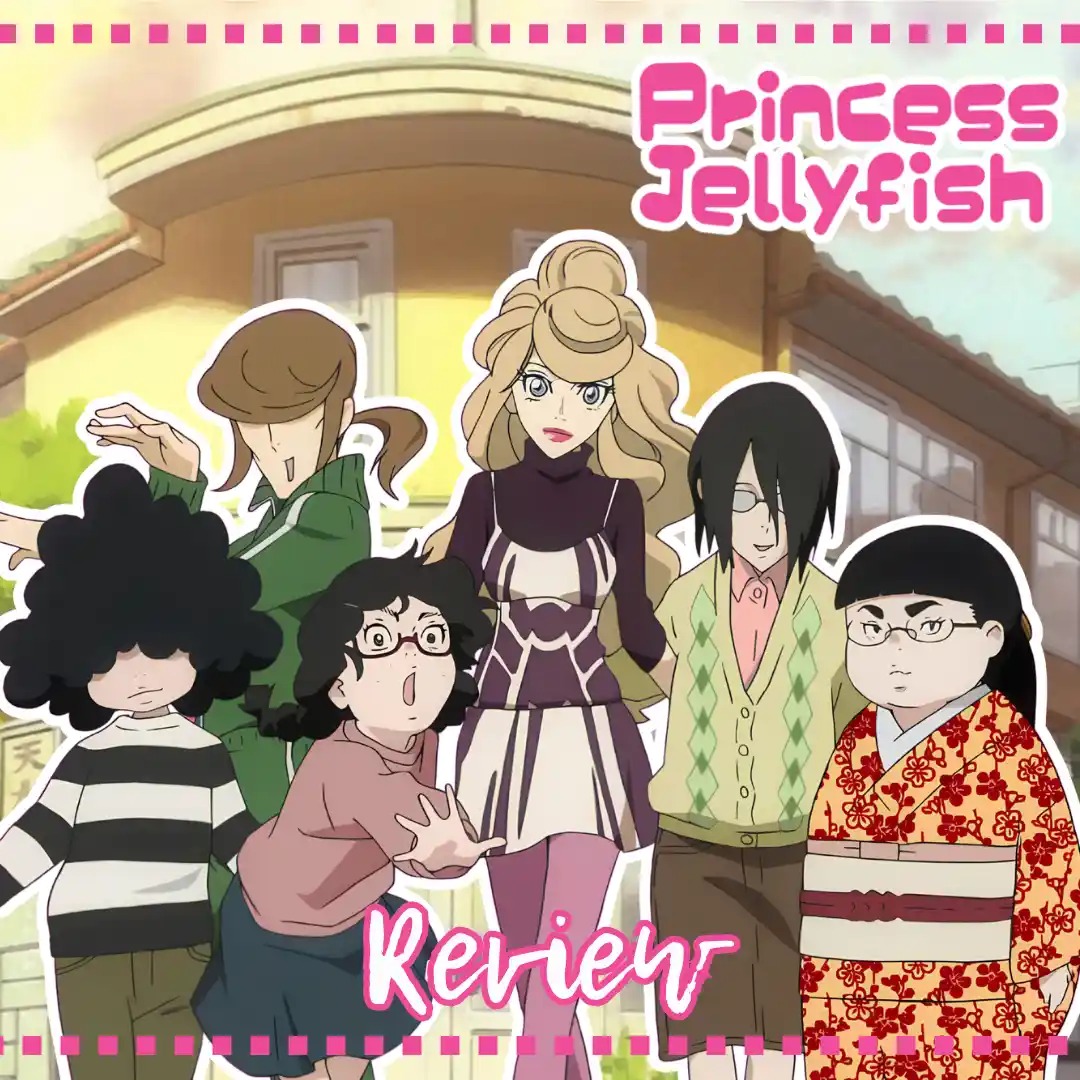
Princess Jellyfish has been sitting on my to-watch list for years, and I somehow never got around to watching it. Then, on 3 November, World Jellyfish Day came along and gave me the perfect excuse (not that I need one) to finally start it.
As someone who has a strong fondness for jellyfish myself, Tsukimi’s obsession was already something I could relate to. I was curious to see how much of the story would revolve around her love of these creatures once episode one started and I met her. As normal, I had no idea what to expect starting and this took many turns.
I watched all 11 episodes in the English dub and watched them all back to back. Between the comedy, the unusual residents of Amamizukan and some rather complicated relationship dynamics, I ended up with a few thoughts.
Bop and pulse your way around the review
Mini-Review

My rating: 8/10
- Humour: High-energy otaku panic paired with an amusing English dub
- Tone: Whimsical and eccentric on the surface with surprisingly heavy subplots
- Characters: A delightfully weird ensemble of misfits
- Romance: Messy, awkward and incomplete
- Vibe: Eccentric and high energy though punctured by surprisingly dark points
| Story | Animation | Sound | Characters | Pacing |
| 7.5/10 | 8/10 | 8.5/10 | 9/10 | 7.5/10 |
A delightfully unique and hilarious Josei comedy with unmatched character chemistry, held back only by its abrupt and incomplete ending.
What is Princess Jellyfish about?
- Genre: Comedy, Slice of Life, Romance, Josei, Crossdressing
- Key Themes: Self-acceptance, sisterhood and community
- Type: Series
- Episodes: 11 (plus 10 short OVA episodes)
- Duration to watch: +/- 4 Hours
- Age rating: PG-13
- Trigger Warning: Non-consensual drugging, sexual misconduct and blackmail
- Release date: October 2010
- Studio: Brain’s Base
- English Dub: Yes
- Source: Manga written and illustrated by Akiko Higashimura
- Kanji: 海月姫
- Alternative title: Kuragehime
- Streaming on Crunchyroll
- Does the story continue in the source material: Yes
- Official website
- Hashtags: #海月姫 #Kuragehime #PrincessJellyfish

Tsukimi Kurashita is a jellyfish-otaku and would much rather spend her time enjoying her usual hobbies than dealing with the outside world. She lives in Amamizukan, an apartment building shared by a group of equally quirky women, each with their own obsessions. Their quiet lives take an unexpected turn when Tsukimi makes friends with a fashionable woman, who turns out to be Kuranosuke Koibuchi, a young man from a wealthy political family. As Kuranosuke becomes part of their little world, the residents find themselves facing challenges, including the threat of losing their home.
My Thoughts on Princess Jellyfish

Heads up, this review is going to be spoiler-heavy. As such, I will first look at the technicals and quick mentions and then get to the more personal thoughts, drama and commentary.
The opening song is includes references and parodies, with nods to Singin’ in the Rain, Star Wars, James Bond and Mary Poppins. I had already noticed some of these during my first watch, but the opening is worth paying attention to because there are details that are easy to miss.
As I mentioned earlier, I watched the English dub, and I had a lot of fun with it, although I also have some reservations. The dialogue and script have great energy that works well with the characters’ eccentric personalities, and there are plenty of one-liners I wanted to save. Some of the wording has aged and is quickly dating the anime, since a lot of them are also ‘meme’ lines. Then there are also the few lines that come across as rather misogynistic (because they are), but the dub’s comedic delivery still works for me. I had fun with the English performances and liked the comedic energy they brought to the dialogue.
On an episode-by-episode level, Princess Jellyfish is an easy series to watch. There is a lot of comedic banter, and the characters’ interactions keep things moving. There is usually another amusing situation or character interaction waiting around the corner, which made it easy for me to watch all eleven episodes in one sitting. The bigger issue is how much story the anime has to fit into those eleven episodes. By the time I reached the final episodes, I just knew that this would not be a complete adaptation. Which was felt, since the ending feels more like a stopping point in a much larger story than a complete conclusion.

Some of the relationship developments and character storylines are left hanging, while the threat to Amamizukan and the fashion project do not receive the sort of resolution I would have liked. Then there is Inari’s manipulation of Shū, another storyline that leaves me wanting answers. I finished the anime with more questions than conclusions, which is one of the reasons I want to read the manga.
I did enjoy the pace of the individual episodes, but I do think the overall adaptation needed more room, as in, where is season 2? The 4-episode character-focused OVA episodes were a welcome addition, and I would have preferred more of those rather than the 6-episode adventure and survival-style OVA. There are so many residents of Amamizukan whose stories I would have liked to spend more time with.
SPOILERS START HERE
Click here to skip to the summary (and skip the character feature to avoid spoilers)
Tsukimi, jellyfish and grief

Tsukimi’s love of jellyfish was one of the main reasons I wanted to watch this series in the first place. As someone who has a genuine fondness for jellyfish, I was happy whenever real jellyfish appeared on screen. Watching them drifting and pulsing through the animated water is lovely, and I enjoyed watching Tsukimi talk about them.
I had expected Clara to play a bigger role, though. She is rescued in the first episode and remains important to Tsukimi, but I kept waiting for her to become more involved in the story. She is a cute presence, and I enjoyed seeing her, but I wanted a little more from the jellyfish who features so prominently in Tsukimi’s life. I also have to question the suitability of Clara’s fish tank. If that material on the bottom is sand or gravel, it does not look like an appropriate setup for a jellyfish.

Something that I found myself wondering during my second watch was: how much of Tsukimi’s obsession comes from her mother? We know that her mother introduces her to jellyfish and connects them to the idea of a princess’s dress. Is Tsukimi’s obsession a way of holding on to that relationship with her mother? When her mother becomes hospitalised, could jellyfish have remained something they could still share, even when so much else had changed? After her mother’s death, perhaps throwing herself into that interest gives Tsukimi something familiar to hold on to.
It may also be a way of avoiding grief that she has not fully processed. I am wondering about this, especially since so many of her Jellyfish memories are connected to her mother.
Tsukimi, Kuranosuke and Shū

My first watch left me uncertain about Tsukimi’s age. I initially had the wrong impression and was thinking of her as much older, perhaps closer to the other residents of Amamizukan. During my rewatch, I caught the confirmation that she is 18. I had missed that detail on my first viewing, and it changed how I looked at some of the relationships. This is exactly why I prefer to watch or read a series at least twice before reviewing it. My first impressions are worth recording, but they are not necessarily where I will land once I have had time to think and notice what I missed.
Knowing Tsukimi is 18 made Kuranosuke’s behaviour around his older brother Shū feel rather different to me. Kuranosuke openly promotes the fact that Tsukimi is a virgin to his 30-year-old brother, and that did not sit comfortably with me on the rewatch. I initially liked the possibility of Tsukimi and Shū together, provided she was older. With her actual age in mind, I am much less comfortable with that idea.
This is a personal subject for me. It does not sit right with me. That is all you need to know, because they are not my stories to share; I was just the friend who saw the fallouts. Now that I am in my 30s, I look back on the situations with even more concern. I have also had too many experiences involving predatory men, both personally and, as mentioned, among friends who were teenagers or had only recently entered adulthood. I know that this makes it difficult for me to be objective about this particular pairing.

My general view has always been that being at a similar stage of life matters more than the age gap alone. There is a difference between someone who is just beginning to work out who they are and someone who is already well into their adult life. In this case, that difference is difficult for me to overlook.
I can appreciate Shū’s feelings without automatically supporting the pairing. From the anime alone, I also don’t want Tsukimi and Kuranosuke to become a romantic couple. I like the friendship they develop, and I prefer the idea of them being able to rely on each other without the story needing to turn that bond into romance.

Kuranosuke is an interesting character in his own right. He initially forces his way into a space where he is clearly not welcome, but as the series progresses, I found myself appreciating his more mature moments. He still has his problematic behaviour, though, and his good intentions do not automatically make every decision acceptable.
The Koibuchi family and Shū

There is a lot going on in the Koibuchi family, and some of it left me with more questions than answers. I found it interesting that the uncle seems quite relaxed about the fact that his brother-in-law cheated on his sister and had a child with another woman. I was glad that he did not hold Kuranosuke responsible for his father’s actions, but I also wanted to know more about that family dynamic.
The episode 7 conversation about Shū’s childhood is particularly uncomfortable. Kuranosuke tries to use what he knows about his father’s behaviour as blackmail, revealing that Shū’s difficulty around women stems from seeing their father with Kuranosuke’s mother. His father responds by saying that he “barely made it to second base”. That attempt to minimise what Shū witnessed rubbed me the wrong way. Whether his father thinks the encounter was limited or not, his son was a child who saw something that affected him. Reducing it to how far the adults got physically does not make the experience less distressing. Hanamori points out that seeing your father with someone who is not your mother would mess with a child’s head. Even if he thinks the information makes for weak blackmail, at least he recognises the impact it could have had on Shū.

I also found myself asking why Shū’s virginity is such a topic of conversation in the first place. Why is it treated as something so unusual or embarrassing that he is still a virgin at 30? The discussions become even more intrusive once people believe he has lost his virginity. His father and uncle seem particularly comfortable discussing, or rather gossiping about, something that should be private. I found that whole attitude frustrating.
Inari and the darker storyline

Shū’s storyline with Inari is where the series became especially difficult for me. I do not like Inari. That is putting it mildly. Her decision to drug Shū, take compromising photographs of him while he is unconscious and use the situation to blackmail him is appalling. It takes the story into some very uncomfortable territory, particularly because Shū does not even realise that he was drugged. Watching him wake up confused and distressed, only to have Inari manipulate him afterwards, was heartbreaking. She repeatedly tries to convince him that he wanted what happened and that he is simply pretending otherwise.

Her behaviour at the tea table in episode 9 was particularly infuriating. She tells him that he enjoys being wrapped around her finger and suggests that, if he really wanted to leave, he would simply do so. I was glad when Shū finally walked away. The fake suicide incident that follows makes things even worse. Shū is genuinely concerned about her because he believes she might hurt herself. Inari knows that he has misunderstood the situation, yet she allows him to worry before turning the whole thing into a drunken prank. I found that incredibly cruel. She earned that slap, and more, although I am not someone who celebrates or condones violence, but this is fiction.

My biggest concern during the first watch was that the series might somehow make Inari and Shū an endgame couple. Please, no. I could not stomach the idea of the person who violated and manipulated him being presented as his romantic destination. His storyline already carries enough trauma without adding that. One of the details that only registered with me later is that Shū does not know he was drugged. That changes how I look at his reactions, especially his concern for Inari and his understanding of what happened between them.
He is responding to a version of events that is not the truth, and I want to know whether the manga ever gives him that information.
The pink dress and the things we leave behind

Tsukimi’s treatment of Kuranosuke’s belongings is another part of the story that changed how I felt about her. She destroys items that belonged to his mother, despite knowing that he has lost her, even if not due to death. I can understand the beads being an accident, as she does not know their significance when she destroys them. However, she still destroyed someone else’s necklace with enthusiasm and without permission.
The pink dress is different. Kuranosuke encourages Tsukimi to make more dresses and tells her she can make as many as she wants. Rather than getting material, she opens his cupboard and finds the pink dress. He tells her that his mother gave it to him. She asks whether he minds, and his voice changes, but he gives her permission because he thinks she means trying it on. Instead, she cuts into it without stopping to consider what he has just told her.
That bothered me.

Kuranosuke makes peace with what she has done, but that does not make her decision acceptable. I also cannot help thinking that if he had taken something her mother left behind and he destroyed it, Tsukimi would not have given him the same grace. She keeps her own mother’s memory prominent and still strongly feels her grief, yet does not show the same consideration for his connection to his mother.

She does not pause, apologise or even take much care to avoid sticking him with pins while working on the dress. Her social awkwardness does not make the lack of consideration disappear. It is one thing to make a mistake when you do not know the history behind an object. It is another to be told what it means to someone and carry on regardless. I found myself feeling rather sorry for Kuranosuke in that moment. He is enthusiastic about helping Tsukimi create something, and the dress is something personal that he has kept from his mother. His making peace with what happened speaks to his maturity, but it does not excuse her callousness.
The Amars, the comedy and the OVA episodes

I enjoyed the group dynamic in Amamizukan. Each of the residents has her own interests, from jellyfish and Japanese dolls to trains and historical figures. Their individual quirks make the group fun to spend time with, and I liked seeing their lives become increasingly tangled with Kuranosuke’s.
Banba was one of the characters whose reactions I appreciated. She is often the more level-headed one when Kuranosuke gets carried away, particularly when he starts pushing the idea of selling the dolls to raise money to save the building. I liked seeing someone step in and challenge him rather than simply going along with every plan.
I also enjoyed Yoshio Hanamori’s character more than I expected. His car-otaku personality is entertaining, but the OVA short featuring him and the cat was a highlight. The cat jumps onto his freshly washed car bonnet, leaves muddy prints and then gets into his lunch. Hanamori stops eating to lift the cat gently off the car and place it on the floor, only for the little troublemaker to help itself to his food. How he treated that cat was going to determine whether I still liked him as a character. Thankfully, he handled it rather sweetly. I liked seeing that gentle side of him, and it made me appreciate the character even more.

I watched the OVA shorts after the main series, and I particularly preferred the character-focused episodes to the adventure and survival-style one. I would have liked more little stories that gave the supporting cast room to breathe.
There are so many personalities in Amamizukan that I could happily have watched more of them simply going about their lives. I did feel a little sorry for Chieko, though. She never gets a makeover in the anime, while the series spends so much time exploring the changes the others go through. It is a small thing, but I would have liked to see her get that moment too. Clara also gets less attention than I expected, and I would have enjoyed seeing more of her.
The references and little details

The series has fun with references, particularly in its opening sequence. There are visual nods to films such as Singin’ in the Rain, Star Wars, James Bond and Mary Poppins. Episode 1 also includes a reference to Heidi during Tsukimi’s jellyfish rescue. The episode titles have their own film-related wordplay too, with the first episode, “Sex and the Sisterhood”, nodding to Sex and the City. I am sure I missed a few, so I would love to know which references other viewers caught.


It is the sort of detail that makes a rewatch worthwhile, especially when the series is already giving you plenty to look at. I also appreciate the small continuity details. In episode 3, Shū gets a cut after a door is slammed in his face. Later in the same episode, he has a plaster over it, tucked beneath his glasses. It is a small detail, but I like seeing things carried through rather than forgotten as soon as the scene changes.
In summary, this anime can be described as…
Princess Jellyfish is a comedy about outcasts finding their footing, with some surprisingly heavy material underneath. It is funny and warm, and the cast makes the world of Amamizukan enjoyable to spend time in. The relationships can be messy, some character choices frustrated me, and the anime stops before the larger story is finished. A funny, awkward josei comedy that stops before it finishes its story.
Strengths and weaknesses

The cast works because each Amar has her own interests and personality, and the group dynamic gives the series much of its warmth. Kuranosuke’s friendship with Tsukimi is one of the strongest parts of the anime. The comedy lands more often than not, particularly in the English dub, and I enjoyed the real jellyfish footage and small continuity details.
The anime adapts only part of the manga, so the ending is incomplete, and storylines such as Shū’s remain unresolved. The relationship dynamics are messy, and the age difference between Tsukimi and Shū is difficult for me to overlook. Some of the dub’s dialogue has aged badly, while the Inari subplot is genuinely difficult to watch.
Hooked by… / Lost by…

The jellyfish, first and foremost, hooked me. Every time a jellyfish appeared on screen, I was happy. Then there is Kuranosuke barging into the Amars’ lives and the comedy that follows, particularly the kimono scene in episode 4. The residents of Amamizukan have such different interests and personalities that I enjoyed spending time in their little world.
The Inari subplot was difficult to watch, and episodes 10 and 11 changed how I felt about Tsukimi, but as the final episodes, it was too late to lose me. Watching her destroy things that mattered to Kuranosuke without stopping to consider what they meant to him was frustrating. I did not stop watching, but I liked her considerably less by the end.
Bingeability: Is it an easy watch?

The 11-episode television series is easy to binge, and I watched it all back to back in one night. At roughly 22 minutes per episode, it takes around four hours to get through. The comedy and short episode count make it tempting to keep going, but the heavier subject matter means it is not always the light watch the premise might suggest. I would recommend it as a short binge, provided you are prepared for some uncomfortable scenes between the jokes.
What will stay with me?

Episode 6 is the moment I keep coming back to. Shū wakes up in the hotel room after being drugged; he is confused, naked and distressed. He is trying to leave, and she is not really letting him leave easily; she keeps getting too close, so he pushes her away and runs away. The scene is uncomfortable to watch because he is clearly flummoxed, uncomfortable and wants to leave.
The aftermath at the Koibuchi home is just as upsetting. Shū stands on the stairs with a blank, distant expression, and it is difficult not to feel for him. He has already been affected by what he witnessed as a child, and now he has been placed in another situation where his boundaries have been violated. The people around him seem far more concerned with the implications for his reputation than with his well-being.
I will also remember Tsukimi’s line in episode 9: “I’m gonna go to sleep and forget all about the horrible stuff. It’s my speciality.” I recognised something in that response. Avoiding difficult feelings and hoping sleep will make them disappear can sound like a throwaway joke, but it also reminded me of one of my own depression indicators. That made the line land rather differently for me.
Favourite moment

I have a soft spot for every scene where we get to see actual jellyfish, so even a short appearance makes me happy. Plot-wise, I particularly enjoyed the scene in episode 4 where Tsukimi struggles with her kimono and Shū walks in at precisely the wrong time. Tsukimi is struggling to take off her kimono, gets frustrated and eventually decides to ask for help while she is still half out of it. She walks into the common area just as Shū arrives. He sees her in her old tank top with the kimono hanging off her, apologises for hugging her earlier, turns around and gets into his car. He refuses to process what he has just seen until he is safely inside his car. Meanwhile, Tsukimi is mortified at the fact that she was in an old tank top and no bra. The scene made me laugh. Shū’s attempt to retreat and Tsukimi’s very specific embarrassment are what make it work.
Character highlights
My least liked character: Shōko Inari

Let’s get her out of the way. I despise Inari and love her. As a character, I have the strongest negative reaction to her, and I love it because it means she is well-written and is good in her role. I despise her because she drugs Shū, uses the staged morning after to blackmail and manipulate him, and in episode 9 turns his concern for her into another way to control him. Not to mention the way she tries to flip the narrative to her victim liking what she is doing. I found her to be incredibly cruel.
Most endearing: Yoshio Hanamori

I did not see this coming, but Hanamori’s car-otaku personality is entertaining, and the OVA short with the cat made me like him even more. His reaction to the cat jumping onto his freshly washed car and then eating his lunch was exactly the sort of small character moment I wanted more of. He handles the kitty so gently.
My most frustrating character: Tsukimi Kurashita

I started the anime wanting to cheer for Tsukimi, but by my second time reaching episode 11 I was increasingly frustrated with her behaviour towards Kuranosuke. Her social awkwardness and passion for making dresses are understandable, but they do not excuse the way she treats his mother’s keepsakes. I feel for her when it comes to her grief and the comfort that she finds in jellyfish, but still, she ends off the series as incredibly self-centred.
The one my heart goes out to: Shū Koibuchi

Shū’s childhood experience, his discomfort around women and what Inari does to him are painful to watch. Plus, even with all that his abuser did, he is still concerned about her when she pretends to commit suicide. Then, to top it all off, he does not know that he was drugged, or that nothing beyond being stripped naked and having the compromising photos happened.
A few quotes I liked from the dub
“Who decided that girls had to be pretty anyhow? I don’t wanna be pretty; I just wanna be me.” ~ Tsukimi Kurashita, Episode 3
“I know it was years ago, but it feels like it was just yesterday. Something reminds me of you, and I start to cry. Days like this, I just want to watch the jellyfish.” ~ Tsukimi Kurashita, Episode 4
“To do battle, you have to dress for battle.” ~ Kuranosuke Koibuchi, Episode 5
“If I’m ever reincarnated, I don’t want to be a human, or a dog, or even a cat, because they can still be cute or ugly. If I’m ever reincarnated, I want to be… I want to be a jellyfish. A jellyfish just rocking and jumping on the waves.” ~ Tsukimi Kurashita, Episode 5
“I’m gonna go to sleep and forget all about the horrible stuff. It’s my speciality.” ~ Tsukimi Kurashita, Episode 9
There are more lines from the English dub in my upcoming Princess Jellyfish quotes collection.
Overall enjoyment and personal reflections

I went in expecting jellyfish and nothing else. In the end, I got a story about grief, loneliness and abuse disguised as a wholesome slice-of-life comedy. The shifts in mood stayed with me for a couple of days after my first watch, which is why I gave myself some time to process everything before going back through the series on 6 November. I had a few questions I kept returning to: what do the characters actually want from each other? How much of their behaviour comes from loneliness, insecurity, trauma or genuine affection? These changed how I looked at several of the characters, especially Tsukimi and Shū.
I enjoyed the series more than I expected; it really drew me in, but I also found myself liking some characters less as I watched. The rewatch was useful because it changed how I viewed Tsukimi and the potential relationships around her. At first I thought she might be older, and that impacted how I felt about the possibility of her and Shū becoming a couple. On my rewatch, episode 1 confirmed that she is 18, which made me reconsider that reaction. It also reminded me of why I don’t like writing a review after only watching it once. Sometimes I miss a detail the first time, which changes how I understand the whole story.
There are still questions I want answered. Like, I want to know whether Shū learns what actually happened when he was drugged, and how much more we learn about Kuranosuke’s mother and his reason for being raised by his father. I also want to see whether Clara and the other residents of Amamizukan get more attention. While researching the info for this review, I learnt that the manga has an official English release, so that is where I plan to go next.
Re-watch value

I have already watched the series twice, and the second viewing gave me a different experience. It helped me catch quite a few details that I had missed the first time, reconsider Tsukimi’s age and the relationships around her, and collect the English dub quotes I wanted for a separate post. I would revisit individual episodes for the comedy, the character interactions and the jellyfish, especially episode 4. I would be more selective about when I watch the heavier episodes involving Inari and Shū, though. I don’t think I would immediately sit down for another full rewatch, but I can see myself returning to this anime from time to time in the future.
Would I recommend Princess Jellyfish?

If you enjoy character-driven comedy, unusual friendships and found family and stories about people finding a place where they belong, then yes. I would not recommend going into it expecting a light romantic comedy, however. Nor expect a complete adaptation.
Does Princess Jellyfish have a satisfying ending? For me, not entirely. The anime has only 11 television episodes, and several storylines feel as though they are still developing when the series ends. I expected an incomplete adaptation, and that is very much how it feels. I want to read the manga to find out what happens beyond the anime.
Questions I am taking to the manga

The manga has an official English release, so I want to read it and find out what happens beyond the anime. There are several questions I am particularly interested in having answered.
- Does Shū ever learn that the night he was drugged involved photographs rather than what Inari led him to believe?
- Does his storyline receive more care, and do the people around him ever acknowledge what happened to him?
- Does Tsukimi’s relationship with Shū develop differently in the manga, and how does her age affect the way that relationship is presented?
I also want to know whether Tsukimi’s relationship with Kuranosuke remains a friendship or develops into something else.
- Does Chieko get more development or a makeover? Does Clara play a bigger role?
- Do we learn more about Tsukimi’s mother and her influence on Tsukimi’s love of jellyfish?
There are questions about the rest of the Koibuchi family too.
- Does Kuranosuke ever reunite with his mother?
- Do we learn more about why he was taken to live with his father?
- Does Keiichiro ever properly acknowledge how his affair affected Shū?
- And when do the Amars learn that Kuranosuke is a man?
I have plenty of reasons to pick up the manga, and I am looking forward to seeing which of my questions it answers.
Have you watched Princess Jellyfish? Will you watch it?
What did you think of Inari and her actions? If you’ve read the manga, is it worth continuing straight from the beginning after watching the anime? Let me know in the comments below!
Date Watched: 3 November 2026
All of the screenshots, GIFs, and videos that are used in this post are from the anime series, Princess Jellyfish (海月姫). The images belong to their respective copyright holders and are not owned by me. They have been sourced from the anime and are included in this review for commentary and discussion purposes.





Leave a Reply