
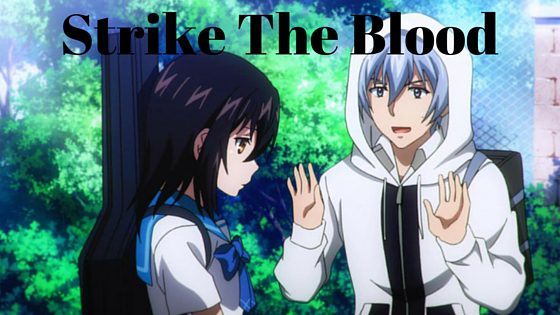
Strike the Blood is another review pulled from the very beginning of this blog. I originally posted it on 3 December 2015, when my entire review amounted to explaining the premise and then basically saying: I enjoyed it, but what was that ending? That was genuinely my main takeaway.
My memories of actually watching Strike the Blood are tied to a very specific time, though. I started it with my then-boyfriend, now husband, while we were housesitting. We were curled up on the couch watching what I thought was an English dub, completely unaware that the dub I’d found was actually fan-made. Then it disappeared. We suddenly had to switch back to subtitles, and years later I ended up going down an entire rabbit hole trying to work out what had happened to the Strike the Blood English dub.
As for the anime itself, the series had vampires, supernatural battles, a ridiculously powerful protagonist who didn’t particularly want to be ridiculously powerful, and a Sword Shaman assigned to watch him in case he became dangerous. Apparently that combination was enough for me. I enjoyed it. I just wish it had ended differently.
Take a bite out of the review
Quick review

- Vampires: Less gothic horror, more supernatural power system with blood as the activation key.
- Action: Frequent magical battles built around Kojou’s familiars and Yukina’s spear.
- Harem: Keeps expanding whether Kojou is prepared for it or not.
- Fan Service: Very much part of the formula, especially whenever Kojou needs blood.
- Ending: Unexpected, clever in what it reveals, but still not how I wanted Season 1 to finish.
What is Strike the Blood about?
- Full genre list: Action, ecchi, fantasy, supernatural, harem, school, urban fantasy, and vampire
- Key themes: Power, responsibility, supernatural coexistence, trust, blood, duty, and control
- Type: TV series
- Episodes: 24
- Duration to watch in full: Approximately 9 hours 30 minutes
- Age restriction: R+ – Mild Nudity
- Trigger warnings: Blood drinking, fantasy violence, blood and gore, sexualised situations, fan service, partial nudity, supernatural threats, and terrorism
- Release date: 4 October 2013-28 March 2014
- Animation studio: Silver Link and Connect
- English dub: No official English dub
- Source: Light novel by Gakuto Mikumo, illustrated by Manyako
- Kanji: ストライク・ザ・ブラッド
- Alternative title: SutoBura
- Average rating: 6.9/10
- Where to stream: Crunchyroll, Prime Video, Animation Digital Network
- Does the story continue in the source material? Yes.
- Official website
- Official hashtag: #ストブラ

Kojou Akatsuki is a high-school student living on Itogami Island, an artificial island where humans and supernatural beings live alongside one another. He also happens to be a vampire, and not just any vampire either. Kojou is believed to be the Fourth Progenitor, an exceptionally powerful vampire whose existence could upset the balance between the world’s established vampire powers. The problem is that Kojou doesn’t behave much like the terrifying vampire everyone expects. He is reluctant to show his powers and hasn’t even tasted human blood, which becomes a problem because his familiars won’t properly accept him without it. Yukina Himeragi is a teenage Sword Shaman apprentice sent by the Lion King Organization to observe Kojou. If he proves dangerous, she is supposed to eliminate him. Instead, she increasingly ends up fighting beside him as supernatural incidents begin occurring around Itogami Island and Kojou is forced to rely more heavily on abilities he never particularly wanted in the first place. There is just one slightly awkward complication: blood.
My thoughts on Strike the Blood
Spoilers from this point onwards for Strike the Blood Season 1.
My original review was tiny, but the one thing I was absolutely certain about was that I enjoyed Strike the Blood. I just wished it had ended differently.
The setup clearly worked for me. Kojou is supposed to be this tremendously powerful Fourth Progenitor who could disrupt the supernatural balance of power, but the person actually carrying that title is a high-school boy who seems far less interested in dominating anyone than everyone around him expects. He would quite happily continue being a student. Unfortunately for him, the universe has other plans.
Then Yukina is sent to watch him and kill him if necessary. That gives the two of them a strange starting point because she is technically there as his observer and potential executioner, yet she increasingly becomes the person standing next to him whenever things go wrong. There is something inherently funny about sending a teenage girl to secretly observe a teenage vampire and then expecting that arrangement to stay remotely uncomplicated, especially when Kojou knows she is following him.
The blood-drinking mechanic also makes the vampire side of Strike the Blood almost impossible to separate from its ecchi and harem elements. Kojou begins as what I rather bluntly called a “virgin vampire” in my original review, meaning he hasn’t tasted human blood. His familiars won’t properly accept him until he does, so drinking blood becomes directly connected to his ability to fight.
When the people around him are threatened, he eventually has to cross that line, and because this is Strike the Blood, it is very rarely presented as a purely practical medical procedure. The sensual side is intentional, and conveniently for the harem setup, the situations that trigger his vampiric urges also tend to involve whichever girl is currently central to the arc.
Subtle? No. Effective at establishing the formula? Absolutely.
It also means the harem isn’t simply sitting beside the supernatural plot. It is built into the mechanics of Kojou’s powers.
Most of the series follows a fairly comfortable arc structure. A supernatural problem appears, Kojou and Yukina get pulled into it, another character becomes involved, and somewhere along the way Kojou inevitably needs more power, which usually means blood.
The downside is that this can make the arcs feel structurally similar. New threat, new supernatural rules, Kojou gets involved, someone gets endangered, Kojou needs blood, familiar appears, and the problem gets hit with an increasingly ridiculous amount of supernatural power. I’m simplifying it horribly, but the pattern is there.
Thankfully, the individual supernatural ideas change enough to stop the series from feeling completely repetitive. Itogami Island is a Demon Sanctuary, so supernatural beings aren’t hiding away from human civilisation in the traditional vampire-story sense. Vampires, demons, spirits, artificial lifeforms, and magic users can all exist within the same setting, which gives Strike the Blood a lot of freedom when introducing each new problem.
The world continually adds new factions, magic systems, creatures, and political complications surrounding Kojou’s position as the Fourth Progenitor. That position matters because Kojou isn’t simply strong. His existence has political implications, since the other Progenitors already form part of an established balance of power. A new one appearing unexpectedly is going to make people nervous.
The funny part is that Kojou himself often feels considerably less intimidating than the title attached to him. As his circle grows, so does the number of people he has to protect, which forces him to use more of the power he initially seems reluctant to embrace.
Yukina is obviously the most important person in that setup. She starts as his observer, but that professional distance does not last particularly long. She repeatedly ends up standing beside him in battle, and the dynamic between the two becomes one of the most consistent parts of the series.
Her Schneesturm Wolfin also gives her a very different fighting style from Kojou. She isn’t standing around waiting for him to solve everything; she regularly throws herself straight into the same danger.
Then there is Asagi. She became one of the characters I clearly remembered afterwards, and looking back at the comments on my original review, someone mentioned the “cyber queen” and my immediate response was: “I love how her AI does things that she isn’t even aware of.” Apparently that detail was important enough for me to remember even if I neglected to put it in the actual review.
Then there is the harem, and yes, it grows. Yukina, Asagi, Sayaka, La Folia, and other girls become increasingly entangled in Kojou’s life, although Yukina remains the relationship the anime pushes hardest.
Kojou himself doesn’t exactly behave like someone carefully assembling a collection of romantic prospects, which is probably why the dynamic worked well enough for me. A lot of it simply happens to him.
The fan service is much harder to separate from the series. Blood drinking is intentionally sensual, and the anime knows exactly what it is doing with that setup. If ecchi bothers you, Strike the Blood is probably going to become irritating quickly. For me at the time, apparently it didn’t stop me enjoying the series.
The action itself isn’t particularly gruesome for a vampire anime. It leans far more towards supernatural spectacle, summoned familiars, magic, and weapon clashes than horror. So if you come to Strike the Blood expecting something closer to Hellsing, you’re looking in the wrong direction.
Then we reach Episodes 23 and 24. The final arc introduces Reina, a girl who arrives from the future while pursuing an artificial magical beast. By the end, the anime reveals that she is Kojou and Yukina’s daughter from 20 years in the future. It also reveals Moegi, another future daughter connected to Kojou and Asagi.
That is a lot of information to drop into an ending. My immediate reaction in 2015 was that the jump to the future felt random, and I still think that describes it rather well. At the same time, I also thought it was clever because, in a very short amount of time, the ending answers several questions about where these relationships might eventually lead and gives us a glimpse of a future far beyond the point the anime has currently reached.
It is efficient. I just don’t particularly like it as the conclusion to Season 1.
Instead of feeling like the natural destination of the story I’d just spent 24 episodes watching, it feels like someone briefly opens a door into a completely different point in the timeline, lets me peek through it, and then shuts it again.
Interesting? Definitely. Satisfying? Less so.
I think my problem is that I wanted to watch the characters reach those answers rather than simply being shown the result. The future jump gives information, but it skips the journey, and that contradiction is probably the best description of my original reaction to Strike the Blood.
I enjoyed the series. I liked what the finale told me. I just didn’t like the way it chose to tell me.
About the animation, sound, and pacing
This is one area where my original notes give me absolutely nothing to work with. I didn’t record specific thoughts about the animation, soundtrack, fight choreography, or pacing in 2015, and I would rather say that plainly than retrofit opinions onto my original watch more than a decade later.
What I can say is that the 24 episodes are divided into relatively short story arcs, usually spanning several episodes each. That structure makes it fairly easy to continue from one arc into another. Anything more specific would need a re-watch.
In summary, this anime can be described as…
Strike the Blood is a supernatural vampire action series where blood drinking, magical battles, and harem mechanics are tied together so tightly that separating them would probably break Kojou’s entire power system.
Fun enough that I enjoyed the ride, even if the final detour into the future still feels strange.
Strengths and weaknesses
Strengths
- Kojou being far less threatening than his Fourth Progenitor reputation suggests gives the premise an entertaining contrast.
- Kojou and Yukina work well as a fighting pair.
- The vampire mechanics are tied directly into the supernatural battles rather than simply being part of his character design.
- Itogami Island gives the story plenty of room for different supernatural species, abilities, and threats.
- The future reveal answers several relationship questions very quickly.
Weaknesses
- The arc structure can become predictable.
- The harem expands faster than some of the characters can be developed.
- Fan service is tied directly into the power mechanics, so there isn’t really any escaping it.
- The final time-travel arc feels disconnected from much of what comes immediately before it.
- Season 1 ends by showing us an interesting future rather than properly arriving at one.
Hooked by… / Lost by…
Hooked by…
The idea of the Fourth Progenitor being a reluctant teenage vampire who hasn’t even properly figured out his own powers yet. Kojou is supposedly one of the most dangerous vampires in existence, yet he hasn’t even drunk human blood and doesn’t particularly want the position he has been dropped into.
His reputation and Kojou himself don’t quite match, and that gives the story somewhere to go.
Lost by…
The future jump.
“Lost” might be slightly strong because it didn’t make me dislike the series. I actually thought the idea was clever. It just wasn’t where I expected the ending to go, and I would have preferred seeing the characters reach that future naturally.
Apparently, I chose to be both impressed and annoyed.
Bingeability: is it an easy watch?
Yes. Strike the Blood is broken into multi-episode arcs, which makes it very easy to keep saying, “I’ll finish this arc,” and suddenly discover you’ve watched another four episodes. At roughly 23-24 minutes per episode, the full 24-episode season runs for about nine and a half hours.
There is supernatural terminology and a growing number of factions to keep straight, but the immediate conflicts remain easy enough to follow.
What will stay with me
“No, senpai…it’s our fight.”
Of everything in Strike the Blood, that is what followed me for years. Part of that is probably because of the bizarre experience surrounding the fan dub. I heard Yukina say the line in English, believed I was watching an official dub, and then had the dubbed episodes suddenly disappear on me. Years later, I could still hear it.
Then there is the ending. My original review was barely a review at all, yet I specifically took the time to write that the future jump surprised me and that I wished the anime had ended differently. Apparently that contradiction bothered me enough to remain the central point of the review more than a decade later.
Characters that stuck with me
Yukina Himeragi
If one line from a character can live in my head for more than a decade, I think she earns a mention.
Asagi Aiba
My surviving 2015 comment specifically says: “I love how her AI does things that she isn’t even aware of.” Apparently Asagi and her relationship with the island’s technology made an impression even if I didn’t bother putting her in the original review.
Quick questions and answers
What is Strike the Blood about?
It follows Kojou Akatsuki, a high-school student who becomes the immensely powerful Fourth Progenitor. Yukina Himeragi, a Sword Shaman, is sent to monitor him and kill him if he proves dangerous.
Is Strike the Blood a vampire anime?
Yes, although it is much closer to supernatural action and ecchi fantasy than traditional vampire horror. Blood drinking is important because it is connected to Kojou awakening and controlling his familiars, but the series spends far more time on magical battles, supernatural politics, and his growing harem than horror.
Is Strike the Blood a harem anime?
Yes. Several girls develop feelings for Kojou across the series, with Yukina and Asagi among the most important. The harem element is also difficult to separate from the vampire mechanics because blood drinking and Kojou’s powers are so closely tied together.
Is Strike the Blood worth watching?
Yes, if vampire action, supernatural battles, ecchi, and harem anime appeal to you. I enjoyed the series. My biggest complaint was the way Season 1 chose to end rather than the journey getting there.
Is Strike the Blood suitable for beginners?
It could be, but I wouldn’t use it as a completely neutral introduction to anime. The story itself isn’t difficult to follow, but ecchi content, sexualised blood-drinking, nudity, and the harem setup are prominent enough that someone completely new to anime could find it a slightly strange starting point.
If those elements don’t bother you, the supernatural action side is accessible.
Does Strike the Blood have a satisfying ending?
Mixed for me. The future reveal is clever and answers questions about where several relationships are heading, but it comes very suddenly.
I enjoyed what it revealed more than I enjoyed the actual structure of the ending.
Does Strike the Blood continue after Season 1?
Yes. The original television season adapts the first six light novel volumes, while the anime later continues through Kingdom of the Valkyria, Strike the Blood II, Strike the Blood III, Strike the Blood IV, and Strike the Blood Final.
The main light novel story concludes with Volume 22, with later APPEND books adding supplementary material.
Overall enjoyment and personal reflections
I wish younger me had written more. That’s the recurring problem with going back through these early reviews. I clearly watched an entire 24-episode anime, enjoyed it enough to write about it, and then left future me approximately two sentences explaining what I actually thought.
Thanks, 2015 Tessa. Still, those two sentences tell me something useful. I enjoyed Strike the Blood enough that my complaint wasn’t that the story bored me or that I wanted it to end sooner. I wanted a different ending, and that distinction matters.
What has changed is that I now have far more memories surrounding how I watched Strike the Blood than I bothered recording when I actually published the review. I remember sitting with my then-boyfriend while we were housesitting. I remember thinking we had found an English dub, and I remember suddenly having to switch back to subtitles when that dub vanished. I remember Yukina’s line, and apparently I remembered it well enough that it eventually sent me down an internet rabbit hole years later.
The ending still sits strangely with me because I can appreciate exactly what it accomplishes while still not liking how it accomplishes it. The series had already convinced me to care about where Kojou, Yukina, Asagi, and the growing group around them were going, and the future jump technically gives me an answer.
It just skips over everything required to reach it. Maybe that is exactly why it frustrated me. I didn’t just want to know where the characters ended up. I wanted to see them get there.
Re-watch value
I would re-watch Strike the Blood, particularly because this original review left so much unrecorded. At this point, a re-watch wouldn’t only be about revisiting an anime I enjoyed. It would also be an opportunity to see which parts I actually remembered correctly after more than a decade and finally give the animation, fights, characters, and pacing the attention my 2015 review didn’t.
It would effectively be half re-watch, half rediscovery.
Would I recommend it?
Yes, with a very large ecchi-shaped asterisk. If you enjoy vampire anime, supernatural battles, harems, and fan service, Strike the Blood has an easy premise to get into and enough supernatural complications to keep things moving.
Strike the Blood isn’t trying to be vampire horror. If you’re coming from something like Hellsing and expecting monsters stalking through the dark, this is a very different flavour of vampire anime. It is much closer to a school-based supernatural battle series where the vampire protagonist happens to require attractive girls’ blood to unlock increasingly ridiculous amounts of power.
Make of that what you will.
If sexualised blood-drinking and harem mechanics irritate you, those aren’t small background details you can conveniently ignore. They’re baked into how Kojou’s powers work. If that premise sounds entertaining rather than irritating, there is a good chance Strike the Blood will work for you.
Readers interested specifically in vampire anime can also compare it with my Hellsing review, while the combination of vampires and harem dynamics puts it in a very different corner of the genre from Diabolik Lovers.
What did you think? Have you watched Strike the Blood, and which of the girls did you actually expect Kojou to end up with? Did the future reveal work for you, or would you have preferred the story to reach those answers naturally? Who was your favourite member of Kojou’s increasingly complicated supernatural circle? And, most importantly, did anyone else get fooled by that fan dub?
My rating
Original rating: My original 2015 review predates my current 10-point rating system, so I’m not going to pretend I gave Strike the Blood a score that doesn’t exist. What I did record was clear: I enjoyed the series, thought the future jump was clever, and still wished it had ended differently.
Originally posted: 3 December 2015
All Strike the Blood images used in this review are screenshots or promotional imagery from the anime and remain the property of their respective copyright holders. They are used here for commentary and review purposes. I do not claim ownership of Strike the Blood or its associated artwork.




Leave a Reply