
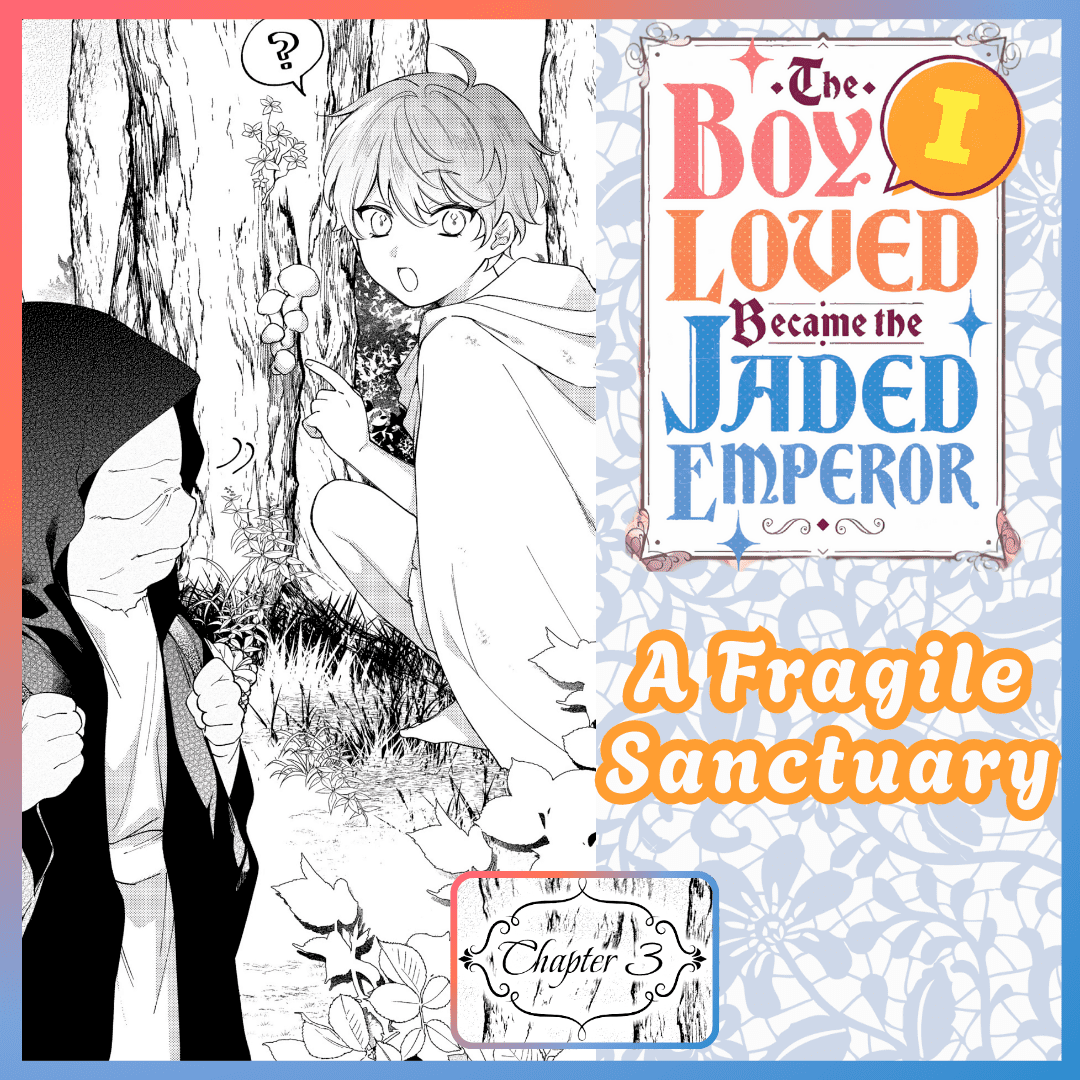
The Boy I Loved Became the Jaded Emperor Chapter 3 shifts from hearthlight sanctuary to catastrophic intrusion. Where Chapter 2 was all food, laughter, and vows of chosen family, this chapter begins with that same warmth but rips it apart. The Demon Woods no longer feel like safety; they become the stage for loss, for endings, and for the empire’s shadow to fall across Ham and Pie.
I’m struck by how this series keeps building contradictions: tenderness and horror, domestic comedy and mass death, fragile belonging and the cold weight of imperial politics. Chapter 3 hurts, but it clarifies exactly why Ham never healed from losing Pie, because it wasn’t just her he lost; it was the entire world they built together over 3 years.
If Chapter 2 gave us family, Chapter 3 shows how quickly family can be stolen.
- Series Title: The Boy I Loved Became the Jaded Emperor
- Status: Complete
- Type: Manga
- Chapter: 3
- Serialisation: Zero-Sum Online
- English Release: September 2024
- Official Link: Kodansha USA
- Genre: Romance, Fantasy, Drama, Court Intrigue, Reincarnation
- Content Warning for this Chapter: Animal death (on-page, mass), fear of pursuit, child neglect, foreshadowed death, survivor’s guilt
Quick Summary (No Major Spoilers)

Previous Context: Chapter 2 ended with Pie rescuing young Alexei (“Ham”) from the death loop in the Demon Woods, feeding him, naming him, and asking him to be her family. Together they vowed to “always stick together.” It was tender and luminous, but also tragic, since the reader already knows from Chapter 1 that this promise will be broken.
Going into this Chapter, I expected quiet bonding, a glimpse of the daily life that makes Pie and Alexei’s vow more than words. I wanted to see what “family” meant for them in practice, and how the manga would balance humour, domestic tenderness, and the looming sense of impermanence.
Summary of The Boy I Loved Became the Jaded Emperor Chapter 3
The chapter opens with Ham and Pie living out their fragile domestic life in the forest: meals, teasing, and mutual declarations that they only need each other to feel safe. Their world feels like a fairy tale made of hearthlight and laughter.
But the tone shifts. Animals flee the woods in panic. Remembering a book, Ham recalls that beasts sense disaster before humans. He and Pie ride a tiger north, believing they’ll be safe.

Instead, they find every beast in the forest gathered in one surreal clearing. Relief blooms until a sudden flash of light drops them all, dead. The ground is littered with corpses. Pie calls out to each by name, Tiggy, Bunny, Owl, but silence answers.
As Ham reels, they hear another sound: armoured footsteps. Imperial Knights step from the trees, surrounding the pair with spears. For the first time, the empire intrudes directly on Ham’s sanctuary.
Tone: Gentle domestic comedy collapses into mass death. The Demon Woods, painted as a sanctuary, are revealed as fragile. The chapter closes on fragile tenderness, a flower placed in Pie’s hood, even as spears close in.
Chapter Purpose: This chapter marks the destruction of the sanctuary. Ham’s family with Pie has been built, and now it is taken away. The arrival of the Imperial Knights ties his personal grief to the empire’s machinery, the same machine that will eventually make him emperor. It explains why Alexei’s reign is haunted not just by Eleonora’s memory, but by the childhood world he lost.
Personal Thoughts and Reactions to The Boy I Loved Became the Jaded Emperor Chapter 3

The comedy at the beginning, Ham’s playful teasing, Pie’s rustic warmth, lulled me into thinking we’d stay in fairytale mode for a little while. I was surprised that three years had passed. I was sad about the death of the animals. They had symbolised innocence and safety, and their sudden mass death forces us to feel the same rupture Ham does.
The tenderness between Pie and Ham is all the more luminous because of this. Lines like “I don’t mind where we go, as long as I’m with you” read like prayers, ones that the story immediately denies.
The knights’ arrival shifted the series in scope. Suddenly, this isn’t just a story about survival in a cursed forest. It’s about empires, armies, and the machinery that will crush Ham’s boyhood once again.
Detailed Story Recap (Spoilers Ahead)
Plot and Story Beats of The Boy I Loved Became the Jaded Emperor Chapter 3
- Ham and Pie begin their morning in the Demon Woods, cooking, washing, and sharing a quiet routine.
- They exchange light teasing; trust deepens through warmth and tender moments.
- Pie lets Ham closer, despite her usual guardedness.
- The peace breaks as woodland animals flee in panic.
- Ham recalls that beasts sense of disaster before humans.
- They mount a tiger to escape the looming threat.
- Ham confesses he would be happy anywhere, as long as Pie is with him and she agrees with him.
- At the forest’s edge, all manner of beasts gather together.
- A blinding flash of light kills every beast instantly.
- Pie cries out their names; Ham realises none survived.
- Footsteps approach, not animals, but people.
- Imperial Knights surround them, closing in.
Character Stakes and Conflict
- Ham (Alexei): Innocent, traumatised, clinging to love. Shows both vulnerability and insight.
- Pie: Protector, beast-mother, grief-stricken but strong. Her nurturing makes her “monster” label deeply ironic.
- Imperial Knights: Faceless figures of empire, new antagonistic force.
- Animals: Named and beloved, their deaths embody lost innocence.

Dialogue and Readability
The dialogue in Chapter 3 feels both tender and foreboding. Ham and Pie’s exchanges carry a raw innocence, framed by the horror of their surroundings. When the animals flee, Ham recalls what he once read, that beasts sense disaster before humans do. His words ground the scene in instinctive dread, while Pie’s quiet trust in him softens the fear. Their ride on the tiger becomes a brief interlude of wild freedom, and the way they speak to each other, promising they would be happy anywhere so long as they’re together, reads almost like a vow. The language is simple, but its weight comes from sincerity.
Readability flows in rhythm with their bond: short, urgent lines when danger presses in, contrasted with gentle, open phrasing in their moments of confession. Pie’s devastation as she calls out the beasts’ names after the massacre stands out because of its unfiltered pain; her voice momentarily cracks the safety of their dreamlike bond. Ham’s dialogue grows heavier in that instant, moving from boyish wonder to grim realisation as he names the truth: everything is dead.
Pacing and Structure
Chapter 3 balances urgency with tenderness. It begins in rising tension as animals flee, then slows for Ham and Pie’s quiet promise of happiness together. That calm is shattered by the sudden massacre of the beasts, throwing the pace into shock and devastation. The arrival of the Imperial Knights sustains the suspense.
Themes and Symbolism Found in The Boy I Loved Became the Jaded Emperor Chapter 3
In Chapter 3, the manga deepens its symbolic language by contrasting the fragile sanctuary with the inevitability of intrusion. The central motif is found family set against imperial power: Pie and Ham’s small, tender world in the Demon Woods represents chosen belonging, while the arrival of the knights embodies inherited authority and violence.

The animals function as symbols of innocence and emotional safety; their trust in Pie and Ham reflects the purity of this space, and their sudden mass death marks the irreversible end of that sanctuary. Flowers continue to operate as visual shorthand for memory, comfort, and emotional truth, framing moments of closeness and foreshadowing their transformation into symbols of loss in Alexei’s future.
Light, previously associated with warmth and protection, is reconfigured as a destructive force through the killing flash, undercutting earlier imagery of luminous safety and reminding us, as the reader, that beauty in this world is often paired with cruelty. Naming and togetherness also carry symbolic weight.
Finally, the chapter’s closing image, the pair standing together before armed authority, crystallises the core symbolic tension of the series: private love versus public power, tenderness versus empire, and the quiet bonds that shape Alexei’s soul long before he is shaped by the throne.
Art Commentary
In Chapter 3, the artwork prioritises emotional rhythm over spectacle, using contrast and composition to guide the reader through intimacy, shock, and dread. The early pages rely on soft linework, rounded panels, and generous white space to create a sense of domestic calm. Medium and wide shots of Pie and Ham talking, laughing, and travelling allow their bodies to rest naturally within the environment, reinforcing a sense of belonging and safety. Floral overlays, drifting petals, and gentle bokeh effects continue the series’ visual language of sanctuary, wrapping moments of closeness in light and texture.


This softness is then deliberately shattered. Panoramic spreads crowded with fleeing animals convey urgency and fragile hope before the killing flash wipes detail away in stark white space, visually enacting sudden loss. Afterwards, blacks deepen, shadows lengthen, and the dead are rendered with uncomfortable clarity, forcing the reader to linger. The arrival of the Imperial Knights introduces rigid verticals and spear lines that cage the protagonists, in sharp contrast to the forest’s organic softness. The chapter closes on the fragile image of a flower in Pie’s hood, briefly restoring tenderness while reframing it as endangered. Through these shifts, the art builds warmth, destroys it, and leaves the reader suspended between memory and impending loss.
Chapter 3 Rating: 9.5/10
Stronger even than Chapter 2 in its cruelty, but necessary, it shows us why Ham becomes the emperor he does, and why Pie’s memory lingers as both wound and vow.
Characters in The Boy I Loved Became the Jaded Emperor Chapter 2
The second chapter deepens the contrast between who these characters were in their youth and who they are now in the cold aftermath of betrayal. What strikes me most is how memory and present reality sit uneasily together; warmth lingers in the flashbacks, but in the present, distance and unfamiliarity dominate. Each character who appears is caught between past connections and present estrangement, revealing fractures not only in relationships but in identity. This tension sets the stage for understanding how promises, family, and loyalty have been reshaped, or shattered, by time and circumstance.
Characters featured:

Alexei (Ham): Still gentle and emotionally open, Ham in this chapter begins to articulate his values. He expresses a desire to be kind, admits his lingering resentment, and chooses love over bitterness. His promise to protect Pie marks an early attempt to claim agency in a life defined by pursuit and control. The massacre of the animals is his first major confrontation with helplessness outside his own suffering, deepening his survivor’s guilt and reinforcing his instinct to shield others.
Pie: Pie continues to frame herself as a “monster,” but Chapter 3 emphasises how little that label reflects her actions. She shows emotional maturity, accepting past cruelty without bitterness and prioritising Ham’s safety over her own pain. Her refusal to resent her family and villagers reveals resilience rather than passivity. By choosing to stay in the woods with Ham, she defines home as relational rather than geographic. Her composure after the massacre suggests experience with loss, hinting at a long history of quiet endurance.
Beasts of the Demon Woods: Their individual naming earlier in the chapter personalises them, making their sudden deaths feel intimate rather than abstract.
Imperial Knights: Introduced at the chapter’s end, the knights represent institutional violence and political inevitability. Unlike previous threats, they are organised, sanctioned, and inescapable. Their silent encirclement contrasts sharply with the warmth of the preceding scenes, reframing Ham and Pie’s private bond as something fragile in the face of empire.
The Boy I Loved Became the Jaded Emperor Chapter 3 Quotes
- “I don’t mind where we go, as long as I’m with you Pie.” – Ham
- “I’d be happy with nothin’ to my name so long as I’m with ya, Ham.” – Pie
- “I’m sorry for not knowing anything” – Ham


Panel Highlight of the Chapter

This panel is where Chapter 3 quietly abandons its fairytale tone. The vertical lines of the knights’ spears form a visual cage around Ham and Pie, replacing flowers and open space with metal and symmetry, and turning the forest from refuge into a trap. Pie instinctively places herself in front of Ham, small and hunched yet defiant, while he stands barefoot and exposed behind her, framed by armoured legs. The knights are faceless and uniform, making the threat feel impersonal and inevitable. Coming immediately after the massacre of the animals, the image allows no space for recovery, layering grief with authority and fear. The composition places Ham and Pie low and dwarfed, yet emotionally central, emphasising that while power surrounds them, humanity belongs only to these two figures.
Overall
Chapter 3 is a stressful chapter. Where Chapter 2 built a sanctuary, Chapter 3 destroyed it, tethering Ham’s personal grief to the imperial politics that will shape his life. It’s a chapter of contradictions: warmth and horror, vows and betrayal, intimacy and intrusion.
Are you reading, or have you read, The Boy I Loved Became the Jaded Emperor?



Leave a Reply