
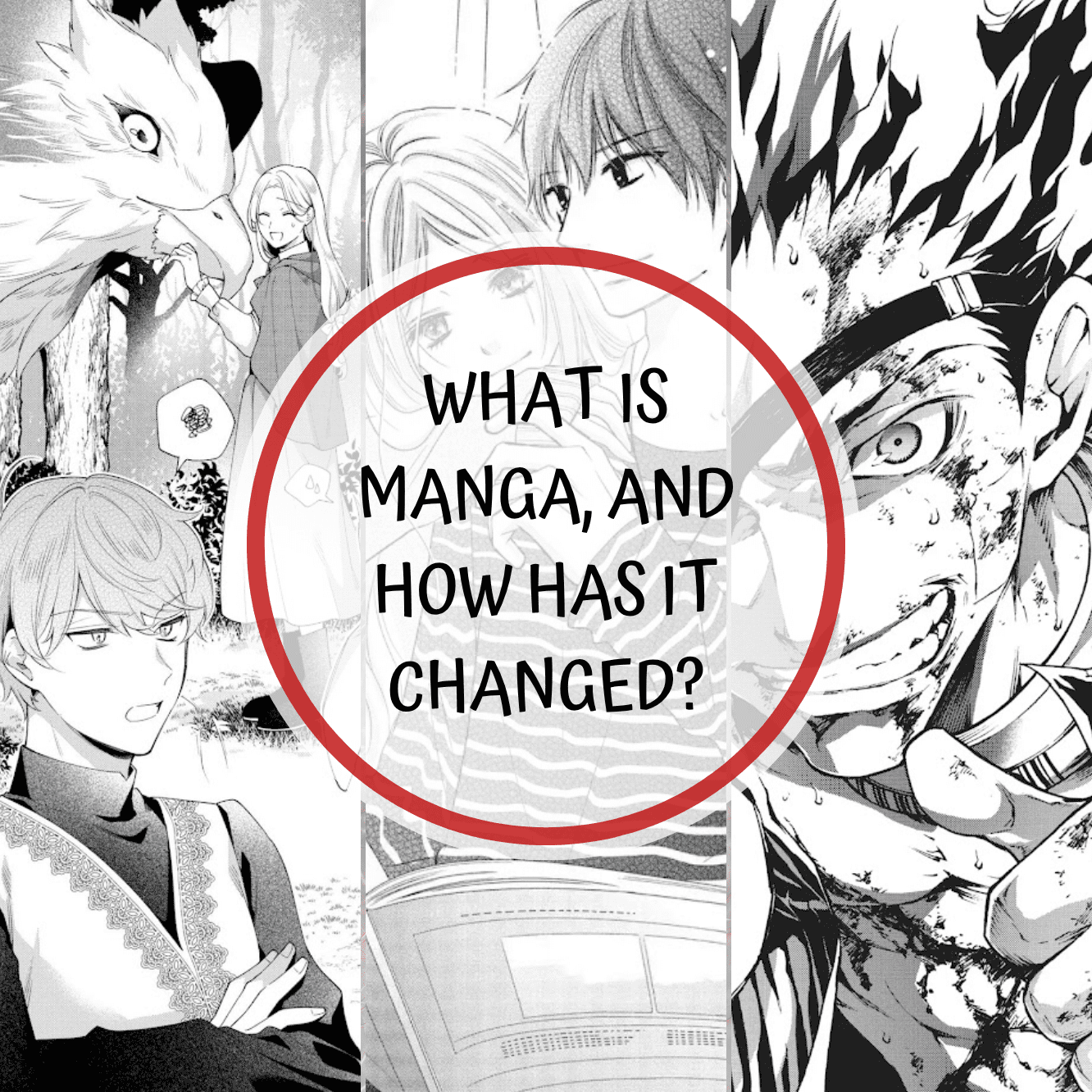
I had been watching anime for quite a few years before I even started to think about where these stories come from. It was only when I worked at a bookstore that I was exposed to manga. It still took a few more years before I picked up a volume. Looking back, that feels like a strange gap, because once I started, it became clear that manga is not just related to anime, for most of the series I love, manga is where everything began. The characters, the story structure, the art style: most of it originated on a printed page long before it ever appeared on a screen.
As someone whose blog is called All About Anime & Manga and who firmly believes animation (and its printed cousin, manga) is first and foremost a storytelling medium that transcends geography, diving deep into manga feels like getting to the very roots of so much of what I love. So let us actually look at what manga is, where it comes from, and why understanding it makes anime itself easier to understand.
Definition of Manga
Manga is Japanese comic storytelling presented through illustrated panels, usually read right to left, and covering all genres and audiences.

Unlike Western comics, which are often in full colour and published as complete graphic novels from the start, traditional manga is almost always black-and-white (with screentones for shading), serialised first in thick weekly or monthly magazines, and later collected into smaller paperback volumes called tankōbon.
As a medium, manga sits at the intersection of sequential art and prose storytelling. It is published in black and white for the most part, read from right to left (following traditional Japanese text direction), and typically released in chapters through monthly or weekly magazines. It covers every genre imaginable, from action and romance to horror, cooking, and workplace drama, and is produced for readers of all ages.
Manga is not a genre. It is a medium, the way that film and anime are mediums. Calling something “manga” tells you the format and origin, not the story type.
Origins of the term

The word manga is often attributed to the ukiyo-e artist Katsushika Hokusai, who used it in the title of his illustrated sketchbooks published from 1814. Those volumes, known as the Hokusai Manga, were not comics in the modern sense; they were collections of sketches and studies, but the word stuck.
The form of manga as sequential storytelling developed more substantially in the late 19th and early 20th century, influenced by Western newspaper comics that entered Japan during the Meiji era. Satirical illustrated strips began appearing in Japanese newspapers and magazines from the 1900s, and by the 1920s and 1930s, comics aimed at children were being published regularly.
The version of manga most readers recognise today took shape after the Second World War. Osamu Tezuka, working in the late 1940s and beyond, is widely credited with establishing the visual and narrative vocabulary that defines modern manga. He introduced large expressive eyes, fluid cinematic panel layouts, and emotionally complex narratives that felt more like film than static comics.
This post-war boom turned manga into a mainstream entertainment industry in Japan, read by people of all ages and social classes, something that still sets it apart from many other countries’ comic cultures.
How Manga Appears in Anime and Manga Storytelling
Most of the anime we watch started life as manga. The medium serves as the blueprint: mangaka (manga artists) create the original story and art, which studios later adapt into animated series, films, or OVAs. This relationship is so tight that many anime only make sense after you’ve read the source manga; the detailed backgrounds, expressive character faces, and panel pacing all originate on the printed page.


In pure manga form, the storytelling relies on visual rhythm. Speed lines, exaggerated expressions, and carefully planned panel sizes control pacing and emotion in ways live-action or Western animation often can’t match. Whether it’s a quiet moment in a rural setting or an explosive battle, manga uses the page itself as a canvas for cinematic storytelling.
Publication and format
Most manga reaches readers through serialisation in weekly or monthly magazines. A mangaka (manga artist) produces a chapter at a time, often working under tight deadlines with a small team of assistants. Those chapters accumulate in a magazine alongside dozens of other series, and once enough chapters exist, they are compiled into a tankōbon, the standalone collected volume that most international readers purchase.

This serialised model has important consequences for how manga stories are structured. Because a mangaka typically does not know in advance how long a series will run, stories are often built around flexible arcs rather than fixed endings. Popular series extend, sometimes for years or decades. Less popular ones get cancelled, occasionally without a satisfying conclusion.
Publication is organised around demographic targets rather than genres. The major categories are shōnen (aimed at young male readers), shōjo (aimed at young female readers), seinen (aimed at adult men), and josei (aimed at adult women). These labels describe the intended readership, not the content — a shōnen manga can include romance, and a josei manga can include action. The categorisation shapes the magazine a series appears in and, broadly, the tone and themes the story tends to explore.
Common Tropes and Patterns

Manga’s serialised nature creates unique patterns:
- Long-running series that span hundreds of chapters (think One Piece still going strong after 25+ years)
- Demographic targeting that shapes tone and themes (more on that in our Shōnen entry)
- Assistant systems where mangaka work with teams under tight weekly deadlines
- Expressive art styles that range from hyper-detailed realism to minimalist chibi
Visual conventions

Manga has a visual language that readers learn to read over time. Panels are arranged on the page in a right-to-left, top-to-bottom order, which can take adjustment for readers used to Western comics. Action lines convey speed and impact. Exaggerated expressions communicate emotion. Characters shift between realistic proportions and highly stylised chibi forms depending on the mood of a scene.
Backgrounds range from highly detailed architectural or natural scenes to deliberately empty space used to focus attention on a character’s emotional state. This contrast between detailed and sparse backgrounds is a consistent visual tool across many manga styles.
How do you read manga?

Manga is read from right to left, following traditional Japanese text direction. That applies to the pages themselves, the panel order on each page, and the speech bubbles within each panel. For most new readers, it feels counterintuitive at first, but the layout is designed with that flow in mind, and most people adjust within a chapter or two. If you want a full breakdown of how the panel sequence works, check out my dedicated guide to reading manga for beginners.
Legal manga reading platforms have changed significantly over the past decade, with official English translations now available the same day chapters are released in Japan. Services like Viz Media’s Shonen Jump app and MANGA Plus by Shueisha have made it easier than ever to read legally and support creators directly, without waiting weeks for a physical volume. If you want a full breakdown of the best platforms available right now, including what each one offers and who it suits best, I have put together a dedicated guide to where to read manga legally in English.
Manga and anime
The relationship between manga and anime is direct. The majority of popular anime series are adaptations of existing manga. When an anime adaptation arrives, it is usually because a manga has already built an audience through serialisation and has demonstrated commercial viability. The manga is the proof of concept; the anime is the adaptation.

This means that reading the manga of an anime series often means reading ahead of or beyond what the anime covers. It also means that when an anime ends before the manga does, which is common, readers can continue the story in its original form. Series such as Berserk, Vinland Saga, and Fullmetal Alchemist all have manga that run significantly beyond any of their anime adaptations or exist in a different form.

Not all anime originates from manga. Some series are adapted from light novels, visual novels, or games. Some are original productions. But manga remains the dominant source medium, and the publishing industry around it is inseparable from the anime industry.
Subgenres, Related Terms & Interlinks

Manga is the source material for most anime adaptations (which then employ seiyuu to bring characters to life). Demographic categories like Shōnen grew directly out of magazine targeting.
Fans who devour manga weekly are classic otaku. And because I view animation as a storytelling art form rather than a geographic label, I also cover its close cousins: Donghua (Chinese animation that often adapts manhua), Manhwa, Manhua, and light novels that frequently become manga adaptations.
How manga differs from manhwa and manhua

Manga is sometimes confused with related comic traditions from neighbouring countries. Manhwa refers to comics from South Korea, and manhua refers to comics from China and the broader Chinese-speaking world. All three share surface similarities; they are East Asian comics with visual styles that overlap, but they have distinct publishing histories, visual traditions, and industries.
A practical difference for readers is reading direction. Manga is read right to left. Manhwa, particularly in its popular webtoon format, is typically read left to right and formatted for vertical scrolling on a screen. Donghua, the term for Chinese animation, is often related to manhua in the same way that anime relates to manga, but the industries and aesthetics are separate.
Evolution of manga

The decades following Tezuka’s work saw manga diversify rapidly.
- The 1960s and 1970s brought chambara and samurai stories, science fiction, horror, and the beginnings of romance-focused shōjo manga. Magazines like Weekly Shōnen Jump, founded in 1968, became cultural institutions. By the 1980s, certain manga properties had become major commercial franchises.
- The 1990s brought globalisation. Dragon Ball, Sailor Moon, and Neon Genesis Evangelion — along with their anime counterparts — introduced manga to readers in Europe, North America, and elsewhere. Dedicated manga sections appeared in bookshops. Publishers began releasing translated editions in both right-to-left format (respecting the original) and flipped left-to-right editions (which have largely disappeared).
- The 2000s saw the industry peak in physical sales in Japan before a gradual decline in print revenue. The 2010s brought a significant shift with the rise of digital manga platforms. Webtoon and similar platforms also emerged during this period, offering a competing model that blurred the line between manga and manhwa stylistically.
The current period has seen manga sales recover substantially, partly through streaming and digital distribution, and partly through global interest in anime driving readers back to source material.
Common misconceptions

One persistent misunderstanding is that manga is a genre. It is not, manga is a medium and a country of origin. Calling something manga tells you it is a Japanese comic; it says nothing about whether the story involves action, romance, horror, or anything else.

A related confusion is the assumption that manga is always black and white. Most serialised manga is indeed printed in black and white, primarily for cost and production speed reasons, but colour pages do appear, typically on the opening pages of a chapter or in special editions. Some manga series are produced entirely in colour.
There is also a tendency among newer fans to treat the anime adaptation as the definitive version of a story. In most cases, the manga came first and is the more complete version. Anime adaptations compress, alter, and sometimes end before the source material does.
Manga Examples

- Berserk by Kentaro Miura — a long-running dark fantasy series that set benchmarks for detailed artwork and mature storytelling, and which influenced generations of manga artists after it.
- Fullmetal Alchemist by Hiromu Arakawa — a complete, self-contained story with a defined ending that the Brotherhood anime adaptation follows closely, making it a clear example of a manga and its adaptation working in parallel.
- One Piece by Eiichiro Oda — the best-selling manga series in history, still ongoing after more than two decades of Weekly Shōnen Jump serialisation.
- Akira by Katsuhiro Otomo — a landmark science fiction manga from the 1980s whose 1988 film adaptation is credited with introducing many international audiences to both manga and anime.
- Sailor Moon by Naoko Takeuchi — a shōjo series that defined magical girl manga through the 1990s and continues to attract new readers.
- Vagabond by Takehiko Inoue — a prestige title in the seinen space, known for its brushwork-based art style and its fictionalised account of the swordsman Miyamoto Musashi.
Understanding manga makes anime make more sense. It explains why certain series have source material that fans argue is better, why some anime end abruptly, and why the art styles, pacing, and storytelling structures of so many series follow familiar patterns. The medium has its own history, its own industry logic, and its own visual vocabulary worth learning.
Related Terms

- Mangaka– the artist (and often writer) responsible for creating a manga series.
- Tankōbon – the compiled volume format in which serialised manga chapters are collected and sold as standalone books.
- Shōnen – the demographic label applied to manga and anime aimed at a young male readership.
- Shōjo — the counterpart to shōnen, referring to manga and anime aimed at a young female readership.
- Light novel — a prose format with manga-style illustrations that, alongside manga, serves as a major source for anime adaptations.
- Donghua — Chinese animation, which relates to manhua in roughly the way that anime relates to manga.
- Otaku — a term for dedicated fans of anime, manga, and related media.
What was the first manga you ever read, and did it come before or after you started watching anime? What are your favourite manga series? Have you ever read the source material after falling in love with the anime adaptation? Drop your recommendations in the comments. I’m always looking for my next read!





Leave a Reply